Showing posts with label Persian. Show all posts

Thursday, June 25, 2009

Act for Iran Now!


Iran has cracked down on hundreds of thousands of protesters who have poured into the streets in an act of breathtaking defiance to protest the contested results of last week's presidential election. Let Iran know that the global community is monitoring their every move! TAKE ACTION:

http://takeaction.amnestyusa.org/siteapps/advocacy/ActionItem.aspx?c=jhKPIXPCIoE&b=2590179&aid=12454

The government of Iran swiftly kicked the machinery of repression into high gear over the last several days in response to the largest public demonstrations of opposition that country has seen in 3 decades. Iranian authorities have violently cracked down on the wave of protesters who have taken to the streets since June 13th in an act of breathtaking defiance to protest the contested results of Friday's presidential election.

Up to 1 million people poured into the streets last Saturday despite a ban on opposition protests. Basij (paramilitary) forces opened fire indiscriminately, killing at least one person and injuring several others. According to reports, as many as five students at Tehran University were shot dead over the weekend and another person was wounded when security agents opened fire on a demonstration. Motorcycle-mounted riot police have severely beaten large numbers of protestors with clubs and night sticks.

Authorities have detained 170 people since June 12, including the brother of former President Mohammad Khatami. Iranian authorities have taken aggressive measures to stifle dissent and stem the flow of information – both inside and outside of the country – about the widespread unrest. Help send a vital message today to Iran's Supreme Leader, Ayatollah Ali Khamenei, that we refuse to remain silent when authorities use bloody violence to crush dissent and deny Iranian citizens their freedom of speech and association:

http://takeaction.amnestyusa.org/siteapps/advocacy/ActionItem.aspx?c=jhKPIXPCIoE&b=2590179&aid=12454


Meanwhile, in England, the doctor who tried to save an Iranian protester as she bled to death on a street in Tehran has told the BBC of her final moments. Dr Arash Hejazi, who is studying at a university in the south of England, said he ran to Neda Agha-Soltan's aid after seeing she had been shot in the chest. Despite his attempts to stop the bleeding she died in less than a minute, he said. Video of Ms Soltan's death was posted on the internet and images of her have become a rallying point for Iranian opposition supporters around the world. Dr Hejazi also told how passers-by then seized an armed Basij militia volunteer who appeared to admit shooting Ms Soltan. Dr Hejazi said he had not slept for three nights following the incident, but he wanted to speak out so that her death was not in vain. He doubted that he would be able to return to Iran after talking openly about Ms Soltan's killing.

Iran protest leader Mir Hossein Mousavi says he holds those behind alleged "rigged" elections responsible for bloodshed during recent protests. In a defiant statement on his website, he called for future protests to be in a way which would not "create tension." He complained of "complete" restrictions on his access to people and a crackdown on his media group.

"I won't refrain from securing the rights of the Iranian people... because of personal interests and the fear of threats," Mr Mousavi said on the website of his newspaper, Kalameh. Those who violated the election process "stood beside the main instigators of the recent riots and shed people's blood on the ground", Mr Mousavi said, pledging to show how they were involved. Mr Mousavi, a former prime minister, spoke of the "recent pressures on me" that are "aimed at making me change my position regarding the annulment of the election". He described the clampdowns he and his staff were facing. "My access to people is completely restricted. Our two websites have many problems and Kalameh Sabz newspaper has been closed down and its editorial members have been arrested," said Mr Mousavi, who has not been seen in public for days. "These by no means contribute to improving the national atmosphere and will lead us towards a more violent atmosphere," he added.

Act for Iran Now!


Iran has cracked down on hundreds of thousands of protesters who have poured into the streets in an act of breathtaking defiance to protest the contested results of last week's presidential election. Let Iran know that the global community is monitoring their every move! TAKE ACTION:

http://takeaction.amnestyusa.org/siteapps/advocacy/ActionItem.aspx?c=jhKPIXPCIoE&b=2590179&aid=12454

The government of Iran swiftly kicked the machinery of repression into high gear over the last several days in response to the largest public demonstrations of opposition that country has seen in 3 decades. Iranian authorities have violently cracked down on the wave of protesters who have taken to the streets since June 13th in an act of breathtaking defiance to protest the contested results of Friday's presidential election.

Up to 1 million people poured into the streets last Saturday despite a ban on opposition protests. Basij (paramilitary) forces opened fire indiscriminately, killing at least one person and injuring several others. According to reports, as many as five students at Tehran University were shot dead over the weekend and another person was wounded when security agents opened fire on a demonstration. Motorcycle-mounted riot police have severely beaten large numbers of protestors with clubs and night sticks.

Authorities have detained 170 people since June 12, including the brother of former President Mohammad Khatami. Iranian authorities have taken aggressive measures to stifle dissent and stem the flow of information – both inside and outside of the country – about the widespread unrest. Help send a vital message today to Iran's Supreme Leader, Ayatollah Ali Khamenei, that we refuse to remain silent when authorities use bloody violence to crush dissent and deny Iranian citizens their freedom of speech and association:

http://takeaction.amnestyusa.org/siteapps/advocacy/ActionItem.aspx?c=jhKPIXPCIoE&b=2590179&aid=12454


Meanwhile, in England, the doctor who tried to save an Iranian protester as she bled to death on a street in Tehran has told the BBC of her final moments. Dr Arash Hejazi, who is studying at a university in the south of England, said he ran to Neda Agha-Soltan's aid after seeing she had been shot in the chest. Despite his attempts to stop the bleeding she died in less than a minute, he said. Video of Ms Soltan's death was posted on the internet and images of her have become a rallying point for Iranian opposition supporters around the world. Dr Hejazi also told how passers-by then seized an armed Basij militia volunteer who appeared to admit shooting Ms Soltan. Dr Hejazi said he had not slept for three nights following the incident, but he wanted to speak out so that her death was not in vain. He doubted that he would be able to return to Iran after talking openly about Ms Soltan's killing.

Iran protest leader Mir Hossein Mousavi says he holds those behind alleged "rigged" elections responsible for bloodshed during recent protests. In a defiant statement on his website, he called for future protests to be in a way which would not "create tension." He complained of "complete" restrictions on his access to people and a crackdown on his media group.

"I won't refrain from securing the rights of the Iranian people... because of personal interests and the fear of threats," Mr Mousavi said on the website of his newspaper, Kalameh. Those who violated the election process "stood beside the main instigators of the recent riots and shed people's blood on the ground", Mr Mousavi said, pledging to show how they were involved. Mr Mousavi, a former prime minister, spoke of the "recent pressures on me" that are "aimed at making me change my position regarding the annulment of the election". He described the clampdowns he and his staff were facing. "My access to people is completely restricted. Our two websites have many problems and Kalameh Sabz newspaper has been closed down and its editorial members have been arrested," said Mr Mousavi, who has not been seen in public for days. "These by no means contribute to improving the national atmosphere and will lead us towards a more violent atmosphere," he added.

Monday, June 22, 2009

Solidarity with Iranians


The Iranian leadership is falling into the same trap that their arch-enemy the Shah of Iran fell into in the 1970s. They are not listening to the people. After a meeting with Shah Reza Pahlavi, the US ambassador William Sullivan complained: "The king will not listen." Soon afterwards, the king had to leave the country, and Ayatollah Khomeini returned from exile in triumph. Khomeini's successor as Supreme Leader, Ayatollah Ali Khamenei, claimed at Friday prayers at Tehran University that "foreign agents" were behind efforts to stage a velvet revolution. This appears to be a classic case of blaming the messenger.

I have no regard for the regime of the former Shah of Iran. As a student activist I opposed him and tried to highlight the injustices of his regime. I was particularly horrified that the Scout Movement, which I was involved with, planned to have its International Jamboree in Iran in 1979. I was criticised for using Private Eye’s epithet for the Shah, “The Sh#t of Iran” in opposing this event but this non-political organisation was hugely naive as the Shah’s son (Who nowadays lives in Potomac, Maryland and answers to “Mr. Pahlavi”) was honoury Chief Scout and the whole operation was to be propaganda for the dynasty.


Grandiosity became the Shah. He staged a pitiful rodeo down in Persepolis to honour his forebears – the Pahlavi dynasty was actually introduced as a British colonial project – to which the great and the good and Princess Anne came along. After months of violent protests, the Shah fled Tehran on 16 January 1979. He ended up in the US where he received treatment for lymphatic cancer, from which he died in 1980. His father, commander of the Persian Cossack Brigade, took power in 1925 and was a genuinely capable and modernising figure in the Ataturk mould but his dictatorial instincts got the better of him. In 1941, on the slimmest of pretexts, the Soviet Union and Britain occupied scrupulously neutral Iran and shamelessly used the countries oil resources for their own wartime benefit. Many don’t realise American troops also entered Iran to assist its allies in the war effort and operated the railway system.


After the war the Soviet Union had nurtured an Iranian communist party and encouraged separatist movements in Northern Iran. They did not leave Iran until the end of 1946 in what was to be the first stress point of the Cold War. The Shah’s son was made leader in his father’s place but at the encouragement of the USA and Britain (who are now concerned about democracy in Iran) he subverted the constitution. Crucially, the Iranian revolution had a messianic leader in Ayatollah Khomeini who was a visible alternative to the Shah, a leader whose claims to legitimacy were compromised even before he came to the throne. The Iranian revolution might well have failed in the early days when Khomeini's courts feared a counter-coup, which was the reason for all the firing squads. They had not forgotten how the CIA and MI6 destroyed Mohammed Mossadeq's democratically elected government in a coup in 1953. Operation Ajax, the Americans called it (the British chose the more prosaic Operation Boot).

There was not much mercy in the Iranian revolution: all the courts did was sentence men to death. But then there hadn't been much mercy before the revolution, when the Shah's imperial guard, the Javidan, or "immortals", slaughtered the crowds. The notorious Savak security service had a well earned reputation for brutality, torture and summary executions, many families were told their loved ones hanged themselves in prison.


Nonetheless the Islamic Republic imposed its doctrines with particular brutality systematically liquidating its allies in the struggle against the Shah hanging thousands, especially women, so that the trees looked like they had roosting bats from a distance. Hundreds of thousands fled into exile. The West’s response was to bankroll Saddam Hussein in the terrible Iran / Iraq war (1980-1988) where the West’s salesmen, including Donald Rumsfeld, sold Iraq the gas and other materials to commit war crimes on the Iranian people. Casualty figures are highly uncertain, though estimates suggest more than one and a half million war and war-related casualties -- perhaps as many as a million people died, many more were wounded, and millions were made refugees. Iran acknowledged that nearly 300,000 people died in the war; estimates of the Iraqi dead range from 160,000 to 240,000. Iraq suffered an estimated 375,000 casualties, the equivalent of 5.6 million for a population the size of the United States. Another 60,000 were taken prisoner by the Iranians. Iran's losses may have included more than 1 million people killed or maimed. It should also be remembered, despite subsequent events in Iraq and Iran’s subsequent bluster that militarily Iran lost the conflict. This and the downing of an Iranian civilian airliner taking off on a scheduled flight from a civilian airport by the US Navy is why Iranians won’t lose any sleep at America’s crocodile tears for the dead of Tehran.

The Ayatollah Khomeini died on 03 June 1989. The Assembly of Experts - an elected body of senior clerics - chose the outgoing president of the republic, Ali Khamenei, to be his successor as national religious leader in what proved to be a smooth transition. In August 1989, Ali Akbar Hashemi-Rafsanjani, the speaker of the National Assembly, was elected President by an overwhelming majority. The new clerical regime gave Iranian national interests primacy over Islamic doctrine. However, today Iran and its people are not well served by the leadership of the Islamic Republic who are definitely second stringers.


Ayatollah Ali Khamenei was a minor cleric promoted rapidly by Ayatollah Khomeini when he realised his health was failing. Like Reza Pahlavi’s son he is not anywhere near the match of his predecessor. Mahmoud Ahmadinejad was an obscure councillor who became Mayor of Tehran because of his links to Islamists. He spent his term in gesture politics towards the poor and rolling back diversity and increasing social control in the city and its institutions. His rise to power and landslide victory in 2005 surprised the international community, which anticipated a win for the incumbent president Ali Akbar Hashemi Rafsanjani. Since then, Mr Ahmadinejad has developed a reputation internationally for his fiery rhetoric and verbal attacks on the West. Meanwhile Iranians have gone backwards economically and socially in a country which even Ruhollah Khomeini described as a “slum”, a very literal description of South Tehran despite years of Ahmadinejad.


Mahmoud Ahmadinejad

The Islamic Republic has sneered at the way the “weak” Shah rolled over to popular protest and is programmed with Iran's Revolutionary Guards and the thuggish Basij militiamen wielding clubs determined to intimidate, mutilate and kill peaceful protestors or “terrorists” as they have been labelled in the Newspeak of the Islamic Republic. It is clear that the Iranian regime had its post-election repression organised in advance. They knew the election was to be rigged, there are no independent observers, no tally sheets, no independence at the election count. Indeed it may be not the first rigging as Ahmadinejad was the surprise winner of the 2005 election with roughly the same share of the vote? If Ayatollah Ali Khamenei believes as he said at Friday prayers that the election couldn’t be rigged as Islam is the religion of truth let him open up the ballot boxes, election registers and tally sheets to inspection. Surely, especially in Islam, truth cries out to be heard?

The fact of the matter is that Persia is a great nation and its people are a great people, rich in language, literature and culture long before the West. They are “Iran” literally the Aryan Nation, after Egypt the world’s first superpower and the home of the Zoroaster, recognised by Islam as “People of the Book” whose prophet was first to proclaim belief in “The One God”, - thus spake Zarathusa. But the truth is that there is little hint of this greatness in the lives of ordinary Iranians who have been badly served by the stupidity of their rulers for a very long time.

There is a velvet rebellion taking place. It is not a revolution yet - but it could evolve into one if the Supreme Leader and his associates do not listen to the people. Dozens of peaceful, young Iranians are saying they want change. Sixty percent of the population are under 30 years old. They have no memory of the Islamic revolution in 1979. Many of them use the internet and watch satellite TV. Their window on the wider world is irreversibly open. Many of them simply want peaceful change - and in particular an end to the strict laws that govern personal behaviour in Iran.

They want to be able to sing and dance. They wonder why the Iranian leadership continue to ban such expressions of human joy - a ban very similar to the rules imposed on Afghanistan during the Taliban regime.


Neda Salehi Agha Soltan, the 26-year-old Iranian woman shot dead during Saturday’s demonstrations in Tehran


At least 10 people were killed in Tehran on Saturday as police clashed with "terrorists" in protests over a disputed poll, Iranian state TV says. State media also said family members of Akbar Hashemi Rafsanjani - a powerful opponent of the re-elected president - were arrested during the protests. Defeated candidate Mir Hossein Mousavi has condemned "mass arrests" of supporters, Reuters news agency says.

Let us do what we can to support the Iranian people in their desire to live free lives, to be true to themselves and be free from doctrinaire and repressive government. One small gesture is if you're on Twitter, set your location to Tehran & your time zone to GMT +3.30. Iranian security forces are hunting for bloggers using location/time zone searches. The more people at this location, the more of a logjam it creates for forces trying to shut down Iranians' access to the internet.

Cut & Paste & Pass it on.

Otherwise I am reminded of the quote from my townsman Edward Fitzgerald’s translation (or more probably re-writing) of the words of the Persian Astronomer and Poet, Omar Khayyam;

“When I want to understand what is happening today or try to decide what will happen tomorrow, I look back.”

Solidarity with Iranians


The Iranian leadership is falling into the same trap that their arch-enemy the Shah of Iran fell into in the 1970s. They are not listening to the people. After a meeting with Shah Reza Pahlavi, the US ambassador William Sullivan complained: "The king will not listen." Soon afterwards, the king had to leave the country, and Ayatollah Khomeini returned from exile in triumph. Khomeini's successor as Supreme Leader, Ayatollah Ali Khamenei, claimed at Friday prayers at Tehran University that "foreign agents" were behind efforts to stage a velvet revolution. This appears to be a classic case of blaming the messenger.

I have no regard for the regime of the former Shah of Iran. As a student activist I opposed him and tried to highlight the injustices of his regime. I was particularly horrified that the Scout Movement, which I was involved with, planned to have its International Jamboree in Iran in 1979. I was criticised for using Private Eye’s epithet for the Shah, “The Sh#t of Iran” in opposing this event but this non-political organisation was hugely naive as the Shah’s son (Who nowadays lives in Potomac, Maryland and answers to “Mr. Pahlavi”) was honoury Chief Scout and the whole operation was to be propaganda for the dynasty.


Grandiosity became the Shah. He staged a pitiful rodeo down in Persepolis to honour his forebears – the Pahlavi dynasty was actually introduced as a British colonial project – to which the great and the good and Princess Anne came along. After months of violent protests, the Shah fled Tehran on 16 January 1979. He ended up in the US where he received treatment for lymphatic cancer, from which he died in 1980. His father, commander of the Persian Cossack Brigade, took power in 1925 and was a genuinely capable and modernising figure in the Ataturk mould but his dictatorial instincts got the better of him. In 1941, on the slimmest of pretexts, the Soviet Union and Britain occupied scrupulously neutral Iran and shamelessly used the countries oil resources for their own wartime benefit. Many don’t realise American troops also entered Iran to assist its allies in the war effort and operated the railway system.


After the war the Soviet Union had nurtured an Iranian communist party and encouraged separatist movements in Northern Iran. They did not leave Iran until the end of 1946 in what was to be the first stress point of the Cold War. The Shah’s son was made leader in his father’s place but at the encouragement of the USA and Britain (who are now concerned about democracy in Iran) he subverted the constitution. Crucially, the Iranian revolution had a messianic leader in Ayatollah Khomeini who was a visible alternative to the Shah, a leader whose claims to legitimacy were compromised even before he came to the throne. The Iranian revolution might well have failed in the early days when Khomeini's courts feared a counter-coup, which was the reason for all the firing squads. They had not forgotten how the CIA and MI6 destroyed Mohammed Mossadeq's democratically elected government in a coup in 1953. Operation Ajax, the Americans called it (the British chose the more prosaic Operation Boot).

There was not much mercy in the Iranian revolution: all the courts did was sentence men to death. But then there hadn't been much mercy before the revolution, when the Shah's imperial guard, the Javidan, or "immortals", slaughtered the crowds. The notorious Savak security service had a well earned reputation for brutality, torture and summary executions, many families were told their loved ones hanged themselves in prison.


Nonetheless the Islamic Republic imposed its doctrines with particular brutality systematically liquidating its allies in the struggle against the Shah hanging thousands, especially women, so that the trees looked like they had roosting bats from a distance. Hundreds of thousands fled into exile. The West’s response was to bankroll Saddam Hussein in the terrible Iran / Iraq war (1980-1988) where the West’s salesmen, including Donald Rumsfeld, sold Iraq the gas and other materials to commit war crimes on the Iranian people. Casualty figures are highly uncertain, though estimates suggest more than one and a half million war and war-related casualties -- perhaps as many as a million people died, many more were wounded, and millions were made refugees. Iran acknowledged that nearly 300,000 people died in the war; estimates of the Iraqi dead range from 160,000 to 240,000. Iraq suffered an estimated 375,000 casualties, the equivalent of 5.6 million for a population the size of the United States. Another 60,000 were taken prisoner by the Iranians. Iran's losses may have included more than 1 million people killed or maimed. It should also be remembered, despite subsequent events in Iraq and Iran’s subsequent bluster that militarily Iran lost the conflict. This and the downing of an Iranian civilian airliner taking off on a scheduled flight from a civilian airport by the US Navy is why Iranians won’t lose any sleep at America’s crocodile tears for the dead of Tehran.

The Ayatollah Khomeini died on 03 June 1989. The Assembly of Experts - an elected body of senior clerics - chose the outgoing president of the republic, Ali Khamenei, to be his successor as national religious leader in what proved to be a smooth transition. In August 1989, Ali Akbar Hashemi-Rafsanjani, the speaker of the National Assembly, was elected President by an overwhelming majority. The new clerical regime gave Iranian national interests primacy over Islamic doctrine. However, today Iran and its people are not well served by the leadership of the Islamic Republic who are definitely second stringers.


Ayatollah Ali Khamenei was a minor cleric promoted rapidly by Ayatollah Khomeini when he realised his health was failing. Like Reza Pahlavi’s son he is not anywhere near the match of his predecessor. Mahmoud Ahmadinejad was an obscure councillor who became Mayor of Tehran because of his links to Islamists. He spent his term in gesture politics towards the poor and rolling back diversity and increasing social control in the city and its institutions. His rise to power and landslide victory in 2005 surprised the international community, which anticipated a win for the incumbent president Ali Akbar Hashemi Rafsanjani. Since then, Mr Ahmadinejad has developed a reputation internationally for his fiery rhetoric and verbal attacks on the West. Meanwhile Iranians have gone backwards economically and socially in a country which even Ruhollah Khomeini described as a “slum”, a very literal description of South Tehran despite years of Ahmadinejad.


Mahmoud Ahmadinejad

The Islamic Republic has sneered at the way the “weak” Shah rolled over to popular protest and is programmed with Iran's Revolutionary Guards and the thuggish Basij militiamen wielding clubs determined to intimidate, mutilate and kill peaceful protestors or “terrorists” as they have been labelled in the Newspeak of the Islamic Republic. It is clear that the Iranian regime had its post-election repression organised in advance. They knew the election was to be rigged, there are no independent observers, no tally sheets, no independence at the election count. Indeed it may be not the first rigging as Ahmadinejad was the surprise winner of the 2005 election with roughly the same share of the vote? If Ayatollah Ali Khamenei believes as he said at Friday prayers that the election couldn’t be rigged as Islam is the religion of truth let him open up the ballot boxes, election registers and tally sheets to inspection. Surely, especially in Islam, truth cries out to be heard?

The fact of the matter is that Persia is a great nation and its people are a great people, rich in language, literature and culture long before the West. They are “Iran” literally the Aryan Nation, after Egypt the world’s first superpower and the home of the Zoroaster, recognised by Islam as “People of the Book” whose prophet was first to proclaim belief in “The One God”, - thus spake Zarathusa. But the truth is that there is little hint of this greatness in the lives of ordinary Iranians who have been badly served by the stupidity of their rulers for a very long time.

There is a velvet rebellion taking place. It is not a revolution yet - but it could evolve into one if the Supreme Leader and his associates do not listen to the people. Dozens of peaceful, young Iranians are saying they want change. Sixty percent of the population are under 30 years old. They have no memory of the Islamic revolution in 1979. Many of them use the internet and watch satellite TV. Their window on the wider world is irreversibly open. Many of them simply want peaceful change - and in particular an end to the strict laws that govern personal behaviour in Iran.

They want to be able to sing and dance. They wonder why the Iranian leadership continue to ban such expressions of human joy - a ban very similar to the rules imposed on Afghanistan during the Taliban regime.


Neda Salehi Agha Soltan, the 26-year-old Iranian woman shot dead during Saturday’s demonstrations in Tehran


At least 10 people were killed in Tehran on Saturday as police clashed with "terrorists" in protests over a disputed poll, Iranian state TV says. State media also said family members of Akbar Hashemi Rafsanjani - a powerful opponent of the re-elected president - were arrested during the protests. Defeated candidate Mir Hossein Mousavi has condemned "mass arrests" of supporters, Reuters news agency says.

Let us do what we can to support the Iranian people in their desire to live free lives, to be true to themselves and be free from doctrinaire and repressive government. One small gesture is if you're on Twitter, set your location to Tehran & your time zone to GMT +3.30. Iranian security forces are hunting for bloggers using location/time zone searches. The more people at this location, the more of a logjam it creates for forces trying to shut down Iranians' access to the internet.

Cut & Paste & Pass it on.

Otherwise I am reminded of the quote from my townsman Edward Fitzgerald’s translation (or more probably re-writing) of the words of the Persian Astronomer and Poet, Omar Khayyam;

“When I want to understand what is happening today or try to decide what will happen tomorrow, I look back.”

Wednesday, May 6, 2009

Jardins Majorelle, Marrakech


In a hot climate the idea of a secluded garden with water at its centre was a haven from the heat and noise and in fact the word so redolent with meaning and symbolism in our culture, “Paradise” comes from the Persian for a water garden. From the time of the Achaemenid dynasty the idea of an earthly paradise spread through Persian literature and example to other cultures, both the Hellenistic gardens of the Seleucids and the Ptolemies in Alexandria. The Avestan word pairidaêza-, Old Persian *paridaida-, Median *paridaiza- (walled-around, i.e., a walled garden), was transliterated into Greek paradeisoi, then rendered into the Latin paradisus, and from there entered into European languages, e.g., French paradis, German Paradies, and English paradise. The word entered Semitic languages as well: Akkadian pardesu, Hebrew pardes, and Arabic firdaws.

As the word expresses, such gardens would have been enclosed. The garden's purpose was, and is, to provide a place for protected relaxation in a variety of manners: spiritual and leisurely (such as meetings with friends), essentially a paradise on earth. The Persian word for "enclosed space" was pairi-daeza, a term that was adopted by Christian mythology to describe the Garden of Eden or Paradise on earth.


The great work of Persian poetry the Rubáiyát of Omar Khayyám (albeit, rewritten and reinterpreted by an Irishman, Edward Fitzgerald) also has the famous Persian Astronomer and Mathematician Hakim Omar-e-Khayyam reflecting on life in a garden.

A Book of Verses underneath the Bough,
A Jug of Wine, a Loaf of Bread - and Thou
Beside me singing in the Wilderness -
Oh, Wilderness were Paradise enow!"


Indeed the great poet and mathematician of Iran, Hakim Omar-e-Khayyam now rests in a Mausoleum which is situated in a beautiful garden in Nishapur. This mausoleum was constructed in 1341 A.H. (1962 A.D.).


Marrakech Riads

Marrakech, known as the "Red City or Al Hamra," is for most visitors defined by two sensations the dust and bustle of the Medina and Souks and the quiet and beauty of the city’s gardens. There are the great public gardens and then there are the Riads or “Garden Houses.” From the outside just a doorway in a cul de sac or Djerb but inside there is a cool courtyard garden with a pool, fountain, overhanging balconies and seating niches in which to relax, read or smoke a shisha. Indeed with the “credit crunch” and accompanying stress many people are turning to their gardens for balm and reassurance from the stresses of modern life. The failure of the vacuous economic model of increasing output and consumption is mirrored by the changes in people’s lives. To define yourself by your ability to consume is as vacuous as a trip through the second floor of Selfridge’s department store in London where air heads validate their empty consumer lifestyle with the flotsam of the throwaway fashion world. Indeed the gardener and plain person’s philosopher Alan Tictmarsh has commented that “Gardening is the new sex!” whilst hastily adding that he preferred the traditional variety. But there is no doubt that people are returning to their gardens for their traditional purpose of a place of rest and reflection and as a personal haven.


A garden Sage

And so back to Marrakech which is one of those places on earth which lives up to the hype. It is an amazing medieval city contained within 12 kms of walls or "ramparts" surrounded by a Francophile "Ville Nouvelle", surrounded by palm groves and overlooked by the High Atlas and with an amazing culture and vitality. There's only one world to define it: magical... There are a thousand legends which describe its history, which began in 1070 when the Saharan Almoravid Abou Beker, the leader of a powerful army, encamped in the plain of Hauz, at the base of the upper Atlas Mountains. Marrakech, the capital of the south, has a mysterious and seductive air. Marrakech, a name with a magical sound that evokes palm groves and caravans, oriental markets and international spies, and duels to the death in an oasis of peace. Many are the roads which lead to Marrakech but the most famous is the P.7, which comes from Casablanca. The crossing of the plain after Ben Guerir, in all its disturbing bareness, lets you understand how Marrakech represents a passage way to the centre of Morocco. More than any other city, it epitomises the idea and the stereotypes of the culture and the traditions of the country. So, it is an excellent starting point for those who want to discover what Morocco can offer in the city which gave the country its name.


Menara Gardens

The pride and joy of Marrakech are its gardens which are taken care of with an age-old passion that dates back to the days of the Almoravids. The truth is that there wouldn't even be a palm tree in Marrakech if these sovereigns hadn't started planting them. Since then, the number of parks has multiplied and no one here finds it strange that a garden, like a building, can boast antique origins. This is the case of the AGuedal o Agdal, a word that means an irrigated garden, created in the XII century by the Almohad Abd el-Moumen. Much smaller and cosier, the garden of the Menara has a pavilion surrounded by cypresses which seems to have been the place where the sultan met his mistresses. As for Marrakech’s famous palm grove, which has an area of 13,000 hectares, it has no less than 100,000 trees. The fastest way to visit it is by car. A more striking way to see the grove is on a classic carriage ride, perhaps preceded by a tour of the ramparts of the hispano-moorish monumental doors. But above all, I recommend a visit to the Majorelle gardens, located north-east of Gueliz in the Ville Nouvelle. Created in the '20s by the French painter Jacques Majorelle, these unique gardens are home to bougainvilleas, coconut, banana and palm trees as well as rare and exotic plants, some of which have strange and menacing forms.


But for me the most wondrous gardens are the ones in the Ville Nouvelle sketched with an artist’s palette of bright gouache paints in cobalt blue, titanium yellow and sea green, the Jardins Majorelle. These iconic gardens were designed by the French painter, Jacques Majorelles who brought an artists eye to the gardens with his wonderful use of colour. In amongst the cacti, bamboos and bougainvillea is the magnificent blue villa housing Museum of Islamic Art. The gardens and museum were restored and are owned by Yves St. Laurent and his partner who have a house in the grounds.


Jacques Majorelle 1950


Jacques Majorelles's House

Jacques Majorelle was born in 1886 in Nancy (France). In 1919 he settles in Marrakech to continue his career as a painter, where he acquires the land for his studio which was going to become the Majorelle garden. After the war in 1947 he opened his garden's doors to the public. Following a car accident, he returned to France, where he died in 1962. In 1980 Pierre Bergé and Yves Saint Laurent purchase the garden and begin to restore it.


The garden contains one of the more important collections of plants of his era where plants of the five continents are exhibited in an enchanting setting. The uniqueness of the place lies in the combination of a luxurious vegetation and architectural elements combining restraint and traditional Moroccan elements. Jacques Majorelle was born in 1886 within a family of artists. His father, Louis Majorelle, was a celebrated cabinetmaker of Nancy. Inspired by his father’s artistic friends he enters the Academy of Fine Arts of Nancy in 1901, and then goes to the Julian Paris Academy. Inspired by the prevailing fashion of the "easel in nature", he is initially inspired by Brittany. It is later in Spain, where he goes to recover from tuberculosis, that he discovers his passion for the south.


There he develops a Mediterranean style of painting inspired by Moorish Andalucia which features strong colours, simple shapes and an originality of subjects. In 1910 he discovers Egypt and the Nile. He views the orient with a new eye, deprived of all orientalist fantasies. In 1919 Jacques Majorelle settles in the medina of Marrakech where he mixes with the French colonial upper middle class. He captures the life of the Souks with their marvellous light and riot of colours. He was also attracted by the Berber regions of the magnificent High Atlas, the geometry of the villages and the Kasbahs of clay fascinated him. The south of Morocco occupied a big part of his existence and the light and vibrancy of Marrakech and Morocco which was later to attract Winston Churchill and many other artists enraptured him and inspired his art.


Date Souk Marrakech - Majorelle depicts complexity with simple shapes


Tourist poster for Tangier


Kasbah, Atlas Mountains

Beside his canvasses, Majorelle created tourist posters for Morocco, and he took part in the decoration of the famous art deco Mamounia hotel in Marrakech. Between 1945 and 1952 the quest of beauty brought him to discover Black Africa (Sudan, Guinea, the Ivory Coast, Niger and Senegal), where he painted a set of canvasses of glaring contrasts, showing a great creativity. Nevertheless, Jacques Majorelle always came back in the haven of peace that he constructed in 1924 in border of palm grove in Marrakech. His main residence, currently the private property of Yves Saint Laurent and Pierre Bergé, was created in the image of Marrakech palaces: architectural simplicity, games of water and lush vegetation. In 1931, the architect Paul Sinoir conceived the blue workshop, nowadays the home of an Islamic Art Museum. Majorelle rushed then created his botanical garden as a setting for his home and studio and brought plants from the whole world: cactus, yuccas, water lilies, jasmines, bougainvillea and much more.


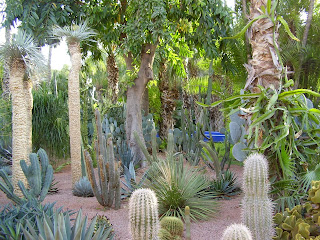


After Majorelle’s death in 1962 the garden remained open to the public but lack of maintenance and money led to its decline. In 1980 Yves Saint Laurent and Pierre Bergé, until there visitors and admirers of the Majorelle garden, purchased it, thus saving it from real estate speculators whose concrete blight had devastated the great inheritance of Marrakech’s gardens. Restoration work started funded by these generous new benefactors and in January 2001 a trust under the discreet patronage of Pierre Bergé et Yves Saint Laurent guarantees the future of these unique gardens. Since the Eighties, the blue workshop, conceived in 1931 by the architect Paul Sinoir houses the Islamic Art Museum. This museum displays the personal collection of Pierre Bergé and Yves Saint Lauren. It exhibits objects of Islamic art coming from Maghreb, Orient, Africa and Asia. In this extraordinary collection we can admire ceramics and potteries of a great value, weapons and magnificent jewellery, textiles, carpets, woodworks and other treasures. A space is also devoted to the works of Jacques Majorelle, creator of the garden.


Yves Saint Laurent was hailed as a 20th century cultural icon who revolutionised the way women dressed. The reclusive Saint Laurent's couture creations won global fine art status and he was widely considered to be one of an elite club of designers including Christian Dior and Coco Chanel who made Paris the fashion capital of the world. From Princess Grace of Monaco to the actress Catherine Deneuve, Saint Laurent's creations adorned many famous women but he was also the first designer to make luxury labels accessible to a wider audience through innovative read-to-wear collections.


Yves Saint Laurent

Saint Laurent and Mr Bergé began collecting art in the 1950s, at a time when the young designer was gaining a worldwide reputation with the fashion house Christian Dior. He needed art "like water to survive", in the words of one dealer, and acknowledged that his creations were inspired by his passion for paintings. Yves Saint Laurent died of cancer aged 71 in June last year. St Laurent, who was born and grew up in Algeria, had a particular affinity with the Maghreb.


Islamic Museum

To my mind the combinations of amazing and eclectic planting and vibrant colour in an enclosed haven with cooling water and enticing vistas makes for a unique garden and setting which is both out of place and at the same time at one with the great Persian traditions of gardens as a place apart, a soothing vision of happiness. Its setting in this great and unique Arab and Berber city with its superb public and private gardens reflecting Man’s inner soul adds to the riches and sensation of this place apart. And in the midst of this special place this is a place apart, one artists vision which others have fallen in love with and lavished with care and thought. Truly this garden stands as a vision of Paradise and no visit to the Red City is complete without sitting in this cooling space and allowing it to work its magic.

See also;

Marrakech Guide;

http://daithaic.blogspot.com/2007/10/marrakech-red-city-on-budget.html


Eileen Gray’s Armchair;

http://daithaic.blogspot.com/2009/02/eileen-grays-armchair.html