Showing posts with label Irish History. Show all posts

Sunday, July 25, 2010

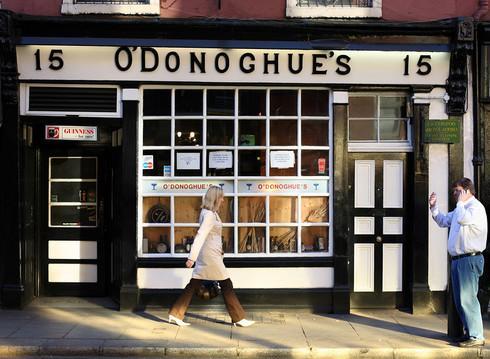
O'Donoghue's Opera


"O'Donoghue's Opera" is a unique and hilarious film starring Ronnie Drew and his band of bohemian merrymakers who include 'The Dubliners' and other favourite Irish musicians of the time like the McKenna’s and Johnny Moynihan. Made in 1965, Ireland's first musical was never completed due to financial difficulties and remained unseen until veteran filmmaker Tom Hayes brought the out-takes to Sé Merry Doyle who painstakingly restored the gem and launched it at the 1998 Dublin Film Festival. Based on the ballad 'The Night That Larry Was Stretched', sung by a young Johnny Moynihan, Ronnie Drew finds himself caught in a hangman's noose as a reward for his dubious career as "the best burglar in all Ireland". The film which is tongue-in-cheek (all the way) has the flavour of an Irish Spaghetti Western and captures the spirit of Dublin camaraderie like no other work before or since. The Guinness, the music, the wit and the grit, its all there in abundance. It says it all, when we see Ronnie fully decked-out in his stripy burglar outfit, trying to evade the law by disguising himself with a pioneer pin.


Ronnie Drew

O'Donoghue's Opera is an Irish film starring Ronnie Drew and his bandmates in The Dubliners. The film is a mock opera, based on the ballad "The Night Before Larry Was Stretched". It was shot in 1965, but was left uncompleted after the film's production ran into financial difficulties. In 1996 filmmaker Sé Merry Doyle oversaw its restoration, and it was first shown at the Dublin Film Festival in the late 1990s. - Wikipedia


The movie “O'Donoghue's Opera” on Google video; approx 37 minutes

“The Night Before Larry Was Stretched” is an Irish execution ballad written in the Newgate cant. The ballad is estimated to have been written around 1816. Will (Hurlfoot) Maher, a shoemaker from Waterford, wrote the song, though Dr. Robert Burrowes, the Dean of St. Finbar’s Cork, to whom it has been so often attributed, certainly did not. The Newgate cant in which the song was penned was a short-lived colloquial slang of 19th century Dublin. "This is only one of a group of execution songs written in Newgate Cant or slang style somewhere around 1780s, others being 'The Kilmainham Minuet', 'Luke Caffrey's Ghost' and 'Larry's Ghost' which, as promised in the seventh verse, comes in a sheet to sweet Molly."


Kimainham Gaol, Dublin

A French translation of the song called ' La mort de Socrate' was written by Francis Sylvester Mahony, better known as “Father Prout” for Froser’s Magazine and is also collected in 'Musa Pedestris, Three Centuries of Canting Songs and Slang Rhymes [1536―1896]', collected and annotated by John S. Farmer. In 'Ballads from the Pubs of Ireland', p. 29, James N. Healy attributes the song to a William Maher, (Hurlfoot Bill), but doesn't note when Maher lived. However, the song is attributed to a 'Curren' in 'The Universal Songster', 1828, possibly being J. Philpot Curran or J. W. Curren.

The song provides the narrative basis for the film 'O’Donoghue’s Opera' which was filmed in 1965 with members of The Dubliners with 'The Night Before Larry was Stretched' performed by Johnny Moynihan. Elvis Costello recorded the song on 1996's 'Common Ground — Voices Of Modern Irish Music'. The film and ballad is based on the strange but true premise that in Dublin jails the tradition grew up of the family and friends being allowed to wake the deceased when he was still alive (!) the night before the hanging as they would not receive the body afterwards as condemned prisoners were buried in quicklime pits in the prison grounds. This may seem strange today and it was a courtesy only extended to “Common Criminals” (Not murderers or political prisoners) at a time in the Georgian era when over 200 crimes, mainly against property, attracted the death penalty. Similarly families were allowed to bring food into prisons otherwise the prisoner would starve. Finally the hangman would be paid to get the prisoner drunk so he wouldn’t show fear on the scaffold.


Execution of Robert Emmet

See; The Years of the French

http://daithaic.blogspot.com/2008/03/years-of-french.html


Lyrics; “The night before Larry was stretched"

I
The night before Larry was stretched,
The boys they all paid him a visit
A bit in their sacks too they fetched
They sweated their duds till they riz it
For Larry was always the lad,
When a friend was condemn’d to the squeezer,
He’d sweat all the togs that he had
Just to help the poor boy to a sneezer
- And moisten his gob ’fore he died.

II
The boys they came crowding in fast;
They drew their stools close round about him,
Six glims round his trap-case were placed
For he couldn’t be well waked without ’em,
When ax’d if he was fit to die,
Without having duly repented?
Says Larry, ‘That’s all in my eye,
And all by the clargy invented,
- To make a fat bit for themselves.

III
‘’I'm sorry dear Larry’, says I,
‘For to see you here in such trouble,
And your life’s cheerful noggin run dry,
And yourself going off like its bubble!’
‘Hauld your tongue in that matter,’ says he;
‘For the neckcloth I don’t care a button,
And by this time tomorrow you’ll see
Your Larry will be dead as mutton:
- And all 'cos his courage was good’


The Dubliners


IV
"And then I'll be cut up like a pie,
And me nob from me body be parted."
"You're in the wrong box, then", says I,
"For blast me if they're so hard-hearted.
A chalk on the back of your neck
Is all that Jack Ketch dares to give you;
So mind not such trifles a feck,
Sure why should the likes of them grieve you?
- And now boys, come tip us the deck."

V
Then the cards being called for, they play’d,
Till Larry found one of them cheated;
A dart at his napper he made
The lad being easily heated,
‘So ye chates me bekase I’m in grief!
O! is that, by the Hokey, the rason?
Soon I’ll give you to know you d—d thief!
That you’re cracking your jokes out of sason,
- And scuttle your nob with my fist’.

VI
Then the clergy came in with his book
He spoke him so smooth and so civil;
Larry tipp’d him a Kilmainham look,
And pitch’d his big wig to the divil.
Then raising a little his head,
To get a sweet drop of the bottle,
And pitiful sighing he said,
‘O! the hemp will be soon round my throttle,
- And choke my poor windpipe to death!’

VII
So mournful these last words he spoke,
We all vented our tears in a shower;
For my part, I thought my heart broke
To see him cut down like a flower!
On his travels we watch’d him next day,
O, the throttler I thought I could kill him!
But Larry not one word did say,
Nor chang’d till he came to King William;
- Then, musha, his colour turned white.

VIII
When he came to the nubbing-cheat,
He was tack’d up so neat and so pretty;
The rambler jugg’d off from his feet,
And he died with his face to the city.
He kick’d too, but that was all pride,
For soon you might see ’twas all over;
And as soon as the noose was untied,
Then at darkey we waked him in clover,
- And sent him to take a ground-sweat.


This is a moving and sentimental ballad in 9/8 time about a lad who is about to be hung. They really did put your coffin (trap case) in your cell and let your friends in to wake you on the night before the hanging in Dublin around 1816. Glims are candles.

"Jack Ketch" was the generic name for the hangman, as "Chips" was for a ship's carpenter and so on; the original Jack Ketch was "the common executioner 1663(?)-1686. He became notorious on account of his barbarity at the executions of William Lord Russell and others." A "Kilmainham look" may be something like a Ringsend tango or a Ringsend uppercut (a kick in the groin) - or perhaps not. Kilmainham was the county jail in former times, and later was the scene of the execution of the leaders of the 1916 Rising. Larry may have been confined in Kilmainham or in the Green Street prison, the "new" Newgate which replaced the old Newgate in the 1770s. Kilmainham is remembered in another prison ballad called "The Kilmainham Minit", i.e., "minuet", the dance of the hanged man.

“He came to King William;” - This was an equestrian statue of King William of Orange, erected in 1701 at College Green in Dublin. Always controversial, it was repeatedly daubed, defaced and blown up; in 1929 it was blown up for the last time, and later broken up for smelting. Presumably the bold Larry was important enough to be hanged in the large public space of College Green rather than at the prison itself (Maurice Craig's book on Dublin - whence the information in this paragraph - included an old photo of Newgate, showing the hanging-apparatus over the main door, "as in most Irish gaols")


O'Donoghue's Opera


"O'Donoghue's Opera" is a unique and hilarious film starring Ronnie Drew and his band of bohemian merrymakers who include 'The Dubliners' and other favourite Irish musicians of the time like the McKenna’s and Johnny Moynihan. Made in 1965, Ireland's first musical was never completed due to financial difficulties and remained unseen until veteran filmmaker Tom Hayes brought the out-takes to Sé Merry Doyle who painstakingly restored the gem and launched it at the 1998 Dublin Film Festival. Based on the ballad 'The Night That Larry Was Stretched', sung by a young Johnny Moynihan, Ronnie Drew finds himself caught in a hangman's noose as a reward for his dubious career as "the best burglar in all Ireland". The film which is tongue-in-cheek (all the way) has the flavour of an Irish Spaghetti Western and captures the spirit of Dublin camaraderie like no other work before or since. The Guinness, the music, the wit and the grit, its all there in abundance. It says it all, when we see Ronnie fully decked-out in his stripy burglar outfit, trying to evade the law by disguising himself with a pioneer pin.


Ronnie Drew

O'Donoghue's Opera is an Irish film starring Ronnie Drew and his bandmates in The Dubliners. The film is a mock opera, based on the ballad "The Night Before Larry Was Stretched". It was shot in 1965, but was left uncompleted after the film's production ran into financial difficulties. In 1996 filmmaker Sé Merry Doyle oversaw its restoration, and it was first shown at the Dublin Film Festival in the late 1990s. - Wikipedia


The movie “O'Donoghue's Opera” on Google video; approx 37 minutes

“The Night Before Larry Was Stretched” is an Irish execution ballad written in the Newgate cant. The ballad is estimated to have been written around 1816. Will (Hurlfoot) Maher, a shoemaker from Waterford, wrote the song, though Dr. Robert Burrowes, the Dean of St. Finbar’s Cork, to whom it has been so often attributed, certainly did not. The Newgate cant in which the song was penned was a short-lived colloquial slang of 19th century Dublin. "This is only one of a group of execution songs written in Newgate Cant or slang style somewhere around 1780s, others being 'The Kilmainham Minuet', 'Luke Caffrey's Ghost' and 'Larry's Ghost' which, as promised in the seventh verse, comes in a sheet to sweet Molly."


Kimainham Gaol, Dublin

A French translation of the song called ' La mort de Socrate' was written by Francis Sylvester Mahony, better known as “Father Prout” for Froser’s Magazine and is also collected in 'Musa Pedestris, Three Centuries of Canting Songs and Slang Rhymes [1536―1896]', collected and annotated by John S. Farmer. In 'Ballads from the Pubs of Ireland', p. 29, James N. Healy attributes the song to a William Maher, (Hurlfoot Bill), but doesn't note when Maher lived. However, the song is attributed to a 'Curren' in 'The Universal Songster', 1828, possibly being J. Philpot Curran or J. W. Curren.

The song provides the narrative basis for the film 'O’Donoghue’s Opera' which was filmed in 1965 with members of The Dubliners with 'The Night Before Larry was Stretched' performed by Johnny Moynihan. Elvis Costello recorded the song on 1996's 'Common Ground — Voices Of Modern Irish Music'. The film and ballad is based on the strange but true premise that in Dublin jails the tradition grew up of the family and friends being allowed to wake the deceased when he was still alive (!) the night before the hanging as they would not receive the body afterwards as condemned prisoners were buried in quicklime pits in the prison grounds. This may seem strange today and it was a courtesy only extended to “Common Criminals” (Not murderers or political prisoners) at a time in the Georgian era when over 200 crimes, mainly against property, attracted the death penalty. Similarly families were allowed to bring food into prisons otherwise the prisoner would starve. Finally the hangman would be paid to get the prisoner drunk so he wouldn’t show fear on the scaffold.


Execution of Robert Emmet

See; The Years of the French

http://daithaic.blogspot.com/2008/03/years-of-french.html


Lyrics; “The night before Larry was stretched"

I
The night before Larry was stretched,
The boys they all paid him a visit
A bit in their sacks too they fetched
They sweated their duds till they riz it
For Larry was always the lad,
When a friend was condemn’d to the squeezer,
He’d sweat all the togs that he had
Just to help the poor boy to a sneezer
- And moisten his gob ’fore he died.

II
The boys they came crowding in fast;
They drew their stools close round about him,
Six glims round his trap-case were placed
For he couldn’t be well waked without ’em,
When ax’d if he was fit to die,
Without having duly repented?
Says Larry, ‘That’s all in my eye,
And all by the clargy invented,
- To make a fat bit for themselves.

III
‘’I'm sorry dear Larry’, says I,
‘For to see you here in such trouble,
And your life’s cheerful noggin run dry,
And yourself going off like its bubble!’
‘Hauld your tongue in that matter,’ says he;
‘For the neckcloth I don’t care a button,
And by this time tomorrow you’ll see
Your Larry will be dead as mutton:
- And all 'cos his courage was good’


The Dubliners


IV
"And then I'll be cut up like a pie,
And me nob from me body be parted."
"You're in the wrong box, then", says I,
"For blast me if they're so hard-hearted.
A chalk on the back of your neck
Is all that Jack Ketch dares to give you;
So mind not such trifles a feck,
Sure why should the likes of them grieve you?
- And now boys, come tip us the deck."

V
Then the cards being called for, they play’d,
Till Larry found one of them cheated;
A dart at his napper he made
The lad being easily heated,
‘So ye chates me bekase I’m in grief!
O! is that, by the Hokey, the rason?
Soon I’ll give you to know you d—d thief!
That you’re cracking your jokes out of sason,
- And scuttle your nob with my fist’.

VI
Then the clergy came in with his book
He spoke him so smooth and so civil;
Larry tipp’d him a Kilmainham look,
And pitch’d his big wig to the divil.
Then raising a little his head,
To get a sweet drop of the bottle,
And pitiful sighing he said,
‘O! the hemp will be soon round my throttle,
- And choke my poor windpipe to death!’

VII
So mournful these last words he spoke,
We all vented our tears in a shower;
For my part, I thought my heart broke
To see him cut down like a flower!
On his travels we watch’d him next day,
O, the throttler I thought I could kill him!
But Larry not one word did say,
Nor chang’d till he came to King William;
- Then, musha, his colour turned white.

VIII
When he came to the nubbing-cheat,
He was tack’d up so neat and so pretty;
The rambler jugg’d off from his feet,
And he died with his face to the city.
He kick’d too, but that was all pride,
For soon you might see ’twas all over;
And as soon as the noose was untied,
Then at darkey we waked him in clover,
- And sent him to take a ground-sweat.


This is a moving and sentimental ballad in 9/8 time about a lad who is about to be hung. They really did put your coffin (trap case) in your cell and let your friends in to wake you on the night before the hanging in Dublin around 1816. Glims are candles.

"Jack Ketch" was the generic name for the hangman, as "Chips" was for a ship's carpenter and so on; the original Jack Ketch was "the common executioner 1663(?)-1686. He became notorious on account of his barbarity at the executions of William Lord Russell and others." A "Kilmainham look" may be something like a Ringsend tango or a Ringsend uppercut (a kick in the groin) - or perhaps not. Kilmainham was the county jail in former times, and later was the scene of the execution of the leaders of the 1916 Rising. Larry may have been confined in Kilmainham or in the Green Street prison, the "new" Newgate which replaced the old Newgate in the 1770s. Kilmainham is remembered in another prison ballad called "The Kilmainham Minit", i.e., "minuet", the dance of the hanged man.

“He came to King William;” - This was an equestrian statue of King William of Orange, erected in 1701 at College Green in Dublin. Always controversial, it was repeatedly daubed, defaced and blown up; in 1929 it was blown up for the last time, and later broken up for smelting. Presumably the bold Larry was important enough to be hanged in the large public space of College Green rather than at the prison itself (Maurice Craig's book on Dublin - whence the information in this paragraph - included an old photo of Newgate, showing the hanging-apparatus over the main door, "as in most Irish gaols")


Wednesday, August 26, 2009

Teddy Kennedy


The death of Teddy Kennedy is no doubt a momentous event and the Kennedy Family have always produced mixed feelings in Britain. Kennedy battled a malignant brain tumour first diagnosed in May 2008, which greatly limited his appearances in the Senate; though he survived longer than doctors first expected, he died just before midnight on August 25, 2009 at his home in Hyannis Port, Massachusetts. Here in the UK there is the legacy of their Patriarch “Ambassador” Joe Kennedy who was seen as anti-British and having written off Britain before World War II. A more considered view may have been surprised that had he not reacted well to the British Imperial proposition that because they were “superior” they were entitled to lift up the “White Man’s Burden” and rule a quarter of the world. Their Catholicism was resented in a Britain which still had a certain sectarian undercurrent, all the more so because they were wealthy and successful, and their support for Irish Nationalism stuck in the Great British craw. Not that anybody, whatever their viewpoint, can argue that the partition of a Small Island which was always united has been anything other than a disaster for Irish People, whatever their persuasion. But just as Doctors tell us we can’t defy nature so we can’t undo history. The drivers behind Partition I’ve explored elsewhere;

http://daithaic.blogspot.com/2007/11/towards-somme-personal-journey.html


Ted Kennedy & Barack Obama

However even the Celtic Sage has been taken aback at the amount of invective directed towards Ted Kennedy in what appears to be orchestrated comments in British media which wrongly accuse him of being an IRA supporter and a cheerleader and fundraiser for “ terrorists”. It is perhaps too much with a public figure to expect people to be guided by the good Latin proverb “de mortuis nil nisi bonum” - Never speak ill of the dead, which is based on a declaration by a 6th. Century B.C. Spartan magistrate as the Dead had no ability to defend themselves. Indeed when looking at the bile directed at Ted Kennedy it is not over egging things to recall the words spoken by Anthony in Shakespeare’s “Julius Caesar; “The good that men do is oft' buried with them, whilst the evil they do outlives them.”

One of the more printable comments sums it up;

“Teddy Kennedy may be seen as a great politician and family father-figure in the US, but in the UK he will be remembered mostly for two things:
1. Mary Jo Kopechne and Chappaquiddick,
2. His support for the IRA.
That´s about it.”


Well I have no useful comment to make about Chappaquiddick but Ted Kennedy was NEVER a supporter of the IRA or terrorism. Rather he was a staunch supporter of Irish Nationalism - at one time calling for British troops to leave Northern Ireland - although he was later involved in the peace process leading to the Good Friday Agreement. The unification of the Island of Ireland and the reconciliation of the People of Ireland is a legitimate political cause dating back to Britain’s first attempts to colonise Ireland and is not a view that requires an apology. Nor indeed is it a cause which we should allow crypto fascists masquerading as “Irish Republicans” to hijack or allow patronising British commentators to devalue by sticking religious and tribal labels on this legitimate political aspiration. Indeed it would have been surprising if a staunch supporter of the Civil Rights movement in the United States did not apply the same views to Ireland and genuine Irish Republicanism, not the obscene campaign of the Provisional IRA, has the same history, ideals and aspirations as French and American Republicanism.

http://daithaic.blogspot.com/2008/03/years-of-french.html

Ted Kennedy’s life and career were acted out within the shadow of his brothers’ unworldly and somewhat undeserved aura of saintliness and flecked with both huge failure and considerable success. He became a Democratic Massachusetts senator in 1962, replacing his brother when he resigned to become president, and was re-elected seven times. Senator Kennedy was a dominant force in US politics for almost 50 years.


Ted Kennedy's election to the Senate 1962

A more considered assessment than those found in the British media is provided by Steve Clemons on Huffington Post.

“Sen. (Edward) Ted Kennedy is dead. He was a friend of Ireland and a foe of gunmen. A hero of the less privileged and a champion of peace. The last tower of Camelot is gone but the change he campaigned for all his life in Ireland and in America is happening today in many ways because of him.
The work goes on, the cause endures, the hope still lives and the dreams shall never die.”


President Barack Obama, of whom he was an active supporter, said he was "heartbroken" to hear of his death. "An important chapter in our history has come to an end," he said. "Our country has lost a great leader, who picked up the torch of his fallen brothers and became the greatest United States senator of our time." Senator Kennedy had championed issues such as education and healthcare, central to Mr Obama's first term.

In 2006, Time magazine named him as one of America's "Ten Best Senators" saying that he had "amassed a titanic record of legislation affecting the lives of virtually every man, woman and child in the country". He one of the most effective and popular legislators in American history skilled at forging alliances across party lines: pushing an education initiative with President George W Bush, and immigration reform with Republican John McCain. But he was a fierce critic of the Bush administration, in particular over Iraq and the prisoner abuse scandal.


The Kennedy Brothers, JFK, Robert and Ted

Edward Kennedy was the only one of four brothers to die a natural death. His brother Joseph was killed in an air crash in World War II, and both President John F Kennedy and presidential hopeful Robert F Kennedy were assassinated in the 1960s. He was widely expected to be the next Kennedy in the White House, but he was never able to fully overcome the scandal caused in 1969, when he drove a car off a bridge at Chappaquiddick near his home, killing his female passenger. The incident helped derail his only presidential bid, more than a decade later.


Kennedy Dynasty

But he remained active in politics right up until his death, famously endorsing Barack Obama for the Democratic nomination during a tight race with Hillary Clinton last year. At his death, he was the third longest serving senator in US history. Last week, he asked the Massachusetts governor to change state law to allow a speedy succession when his Senate seat became vacant. Analysts suggest that Senator Kennedy feared a lengthy gap could deny Democrats a crucial vote on Mr Obama's flagship health reform. His death comes weeks after that of his older sister, Eunice Kennedy Shriver, on 11 August. With his passing Jean Ann Kennedy Smith, 81, the sister of President Kennedy is the only surviving child of the nine born to Joseph P Kennedy Snr and Rose Fitzgerald Kennedy. Appointed US ambassador to Ireland in 1993, she now runs a charity which promotes the artistic talents of mentally and physically challenged children.


Kennedy family with Ted in a Boston Hospital

Edward Kennedy sometimes failed to meet the huge expectations placed upon him following the deaths of his older brothers. But his commitment to what he called their "justice, excellence and courage" ensured he guarded their memory fiercely and, despite his flaws, he left a substantial political legacy. He will be missed, especially in Ireland.

“In many ways, he was the last man standing, straddling a mythic family mantle of fame and a vaunted career of political service, all the while wearing the crown of Camelot decades after its heyday...the senator's death brought to a close a storied political era - of assassinations, Jackie O, Palm Beach, Chappaquiddick - and a lifetime of both tragedy and public service. “

Andrea Billup writes in the “The Washington Times” that 'Camelot' fades with Kennedy passing

“He was a Rabelaisian figure in the Senate and in life, instantly recognizable by his shock of white hair, his florid, oversize face, his booming Boston brogue, his powerful but pained stride. He was a celebrity, sometimes a self-parody, a hearty friend, an implacable foe, a man of large faith and large flaws, a melancholy character who persevered, drank deeply and sang loudly. He was a Kennedy. “

“New York Times” journalist John M Broder describes the Kennedy effect.


Teddy Kennedy 1932 - 2009

Teddy Kennedy


The death of Teddy Kennedy is no doubt a momentous event and the Kennedy Family have always produced mixed feelings in Britain. Kennedy battled a malignant brain tumour first diagnosed in May 2008, which greatly limited his appearances in the Senate; though he survived longer than doctors first expected, he died just before midnight on August 25, 2009 at his home in Hyannis Port, Massachusetts. Here in the UK there is the legacy of their Patriarch “Ambassador” Joe Kennedy who was seen as anti-British and having written off Britain before World War II. A more considered view may have been surprised that had he not reacted well to the British Imperial proposition that because they were “superior” they were entitled to lift up the “White Man’s Burden” and rule a quarter of the world. Their Catholicism was resented in a Britain which still had a certain sectarian undercurrent, all the more so because they were wealthy and successful, and their support for Irish Nationalism stuck in the Great British craw. Not that anybody, whatever their viewpoint, can argue that the partition of a Small Island which was always united has been anything other than a disaster for Irish People, whatever their persuasion. But just as Doctors tell us we can’t defy nature so we can’t undo history. The drivers behind Partition I’ve explored elsewhere;

http://daithaic.blogspot.com/2007/11/towards-somme-personal-journey.html


Ted Kennedy & Barack Obama

However even the Celtic Sage has been taken aback at the amount of invective directed towards Ted Kennedy in what appears to be orchestrated comments in British media which wrongly accuse him of being an IRA supporter and a cheerleader and fundraiser for “ terrorists”. It is perhaps too much with a public figure to expect people to be guided by the good Latin proverb “de mortuis nil nisi bonum” - Never speak ill of the dead, which is based on a declaration by a 6th. Century B.C. Spartan magistrate as the Dead had no ability to defend themselves. Indeed when looking at the bile directed at Ted Kennedy it is not over egging things to recall the words spoken by Anthony in Shakespeare’s “Julius Caesar; “The good that men do is oft' buried with them, whilst the evil they do outlives them.”

One of the more printable comments sums it up;

“Teddy Kennedy may be seen as a great politician and family father-figure in the US, but in the UK he will be remembered mostly for two things:
1. Mary Jo Kopechne and Chappaquiddick,
2. His support for the IRA.
That´s about it.”


Well I have no useful comment to make about Chappaquiddick but Ted Kennedy was NEVER a supporter of the IRA or terrorism. Rather he was a staunch supporter of Irish Nationalism - at one time calling for British troops to leave Northern Ireland - although he was later involved in the peace process leading to the Good Friday Agreement. The unification of the Island of Ireland and the reconciliation of the People of Ireland is a legitimate political cause dating back to Britain’s first attempts to colonise Ireland and is not a view that requires an apology. Nor indeed is it a cause which we should allow crypto fascists masquerading as “Irish Republicans” to hijack or allow patronising British commentators to devalue by sticking religious and tribal labels on this legitimate political aspiration. Indeed it would have been surprising if a staunch supporter of the Civil Rights movement in the United States did not apply the same views to Ireland and genuine Irish Republicanism, not the obscene campaign of the Provisional IRA, has the same history, ideals and aspirations as French and American Republicanism.

http://daithaic.blogspot.com/2008/03/years-of-french.html

Ted Kennedy’s life and career were acted out within the shadow of his brothers’ unworldly and somewhat undeserved aura of saintliness and flecked with both huge failure and considerable success. He became a Democratic Massachusetts senator in 1962, replacing his brother when he resigned to become president, and was re-elected seven times. Senator Kennedy was a dominant force in US politics for almost 50 years.


Ted Kennedy's election to the Senate 1962

A more considered assessment than those found in the British media is provided by Steve Clemons on Huffington Post.

“Sen. (Edward) Ted Kennedy is dead. He was a friend of Ireland and a foe of gunmen. A hero of the less privileged and a champion of peace. The last tower of Camelot is gone but the change he campaigned for all his life in Ireland and in America is happening today in many ways because of him.
The work goes on, the cause endures, the hope still lives and the dreams shall never die.”


President Barack Obama, of whom he was an active supporter, said he was "heartbroken" to hear of his death. "An important chapter in our history has come to an end," he said. "Our country has lost a great leader, who picked up the torch of his fallen brothers and became the greatest United States senator of our time." Senator Kennedy had championed issues such as education and healthcare, central to Mr Obama's first term.

In 2006, Time magazine named him as one of America's "Ten Best Senators" saying that he had "amassed a titanic record of legislation affecting the lives of virtually every man, woman and child in the country". He one of the most effective and popular legislators in American history skilled at forging alliances across party lines: pushing an education initiative with President George W Bush, and immigration reform with Republican John McCain. But he was a fierce critic of the Bush administration, in particular over Iraq and the prisoner abuse scandal.


The Kennedy Brothers, JFK, Robert and Ted

Edward Kennedy was the only one of four brothers to die a natural death. His brother Joseph was killed in an air crash in World War II, and both President John F Kennedy and presidential hopeful Robert F Kennedy were assassinated in the 1960s. He was widely expected to be the next Kennedy in the White House, but he was never able to fully overcome the scandal caused in 1969, when he drove a car off a bridge at Chappaquiddick near his home, killing his female passenger. The incident helped derail his only presidential bid, more than a decade later.


Kennedy Dynasty

But he remained active in politics right up until his death, famously endorsing Barack Obama for the Democratic nomination during a tight race with Hillary Clinton last year. At his death, he was the third longest serving senator in US history. Last week, he asked the Massachusetts governor to change state law to allow a speedy succession when his Senate seat became vacant. Analysts suggest that Senator Kennedy feared a lengthy gap could deny Democrats a crucial vote on Mr Obama's flagship health reform. His death comes weeks after that of his older sister, Eunice Kennedy Shriver, on 11 August. With his passing Jean Ann Kennedy Smith, 81, the sister of President Kennedy is the only surviving child of the nine born to Joseph P Kennedy Snr and Rose Fitzgerald Kennedy. Appointed US ambassador to Ireland in 1993, she now runs a charity which promotes the artistic talents of mentally and physically challenged children.


Kennedy family with Ted in a Boston Hospital

Edward Kennedy sometimes failed to meet the huge expectations placed upon him following the deaths of his older brothers. But his commitment to what he called their "justice, excellence and courage" ensured he guarded their memory fiercely and, despite his flaws, he left a substantial political legacy. He will be missed, especially in Ireland.

“In many ways, he was the last man standing, straddling a mythic family mantle of fame and a vaunted career of political service, all the while wearing the crown of Camelot decades after its heyday...the senator's death brought to a close a storied political era - of assassinations, Jackie O, Palm Beach, Chappaquiddick - and a lifetime of both tragedy and public service. “

Andrea Billup writes in the “The Washington Times” that 'Camelot' fades with Kennedy passing

“He was a Rabelaisian figure in the Senate and in life, instantly recognizable by his shock of white hair, his florid, oversize face, his booming Boston brogue, his powerful but pained stride. He was a celebrity, sometimes a self-parody, a hearty friend, an implacable foe, a man of large faith and large flaws, a melancholy character who persevered, drank deeply and sang loudly. He was a Kennedy. “

“New York Times” journalist John M Broder describes the Kennedy effect.


Teddy Kennedy 1932 - 2009

Tuesday, December 9, 2008

Hill of Tara


The Hill Of Tara

TaraWatch is calling on the public, around the world, to make submissions to an advisory group that has been set up by the Irish Minister for the Environment, Heritage and Local Government, to review the current list of potential UNESCO World Heritage Sites in Ireland, known as the Tentative List (of potential nominees as World Heritage Sites).

The Irish Government is currently building the M3 motorway through the heart of the archaeological complex associated with the Hill of Tara, in County Meath, at the same time that it is proposing to nominate Tara to Ireland’s Tentative List. We are asking members of the public to sign our petition and to make submissions, before Friday, January 30th, 2009.

Email your submission to worldheritagetentativelist@environ.ie

Our position is that:

- The Hill of Tara complex qualifies for World Heritage status as a natural and cultural landscape of outstanding universal value, due to its unique cultural significance, and the extent of the surviving remains. Tara covers a much larger area than that the 100 acres of State-owned land on the summit of the Hill, which currently delimits the ‘national monument’. The M3 passes through the middle of the area to be protected.

- The entire Tara archaeological complex and cultural/natural landscape should be declared a World Heritage site. Expert bodies such as the World Monuments Fund, the Heritage Council, have recognised Tara consists of the entire Hill of Tara along with the Tara / Skryne valley, as well as the defensive forts that encircle the hill, including national monuments such as the defensive forts of Rath Lugh (to the east), Rath Miles (to the north) and Ringlestown Rath (to the west), and have called for the re-routing of the M3.

-The M3 motorway, due to open in 2010, should be re-routed outside of the Tara complex, before the site is given UNESCO World Heritage Protection. It would be a breach of the World Heritage Convention for UNESCO to inscribe the site, with the M3 passing through it. This is confirmed by the fact that Tara was placed on the World Monuments Fund, 2008-2010 List of 100 Most Endangered Sites

For more information please visit http://www.tarawatch.org/?p=780


View of Skyrne Hill and Church from The Hill Of Tara at St Patrick's statue


Background on why Tara is so special.

The Hill of Tara (Irish Teamhair na Rí, "Hill of the Kings"), located near the River Boyne, is an archaeological complex that runs between Navan and Dunshaughlin in County Meath, Leinster, Ireland. It contains a number of ancient monuments, and, according to tradition, was the seat of Árd Rí na hÉireann, or the High King of Ireland. Current scholarship based on the research conducted by the Discovery Programme, indicates that Tara was not a true seat of Kingship, but a sacral site associated with Indo-European Kingship rituals.

In Irish mythology it is said to be the sacred place of the Gods and a door way to other worlds. From atop Tara one can see half of the counties in Ireland and other sacred sites like Newgrange and further north the Hill of Slane where Saint Patrick lit his Pascal fire just prior to coming to Tara to confront the ancient pagan religions at their most powerful spot. There are many, many monuments and earthen structures on Tara dating as far back as 2500B.C. along with over 30 visible monuments and even more that have not been discovered.

A grave was found near the hill that is supposedly that of King Lóegaire, who was said to be the last pagan king of Ireland. During the rebellion of 1798, United Irishmen formed a camp on the hill but were attacked and defeated by British troops on 26 May 1798 and the Lia Fáil was moved to mark the graves of the 400 rebels who died on the hill that day. In 1843, the Irish Member of Parliament Daniel O'Connell hosted a peaceful political demonstration on Hill of Tara in favour of repeal of the Act of Union which drew over 750,000 people, which indicates the enduring importance of the Hill of Tara.


Proposed Road

It is also under attack to be ripped and torn in a most sacrilegious manner by those who have no respect for such things and are blinded by greed with tainted hearts filled will corruption. A privately funded toll road is planned to run right through the Tara Hill Valley desecrating the bones of our ancient ancestors and forever scaring the heart of Tara.

This road is needed to be sure, but an alternate route could easily be instigated around the valley saving Tara and protecting it for future generations. However, the National Road Authorities will have nothing to do with this alternate route and plan to go ahead with the original destructive route.

Hill of Tara


The Hill Of Tara

TaraWatch is calling on the public, around the world, to make submissions to an advisory group that has been set up by the Irish Minister for the Environment, Heritage and Local Government, to review the current list of potential UNESCO World Heritage Sites in Ireland, known as the Tentative List (of potential nominees as World Heritage Sites).

The Irish Government is currently building the M3 motorway through the heart of the archaeological complex associated with the Hill of Tara, in County Meath, at the same time that it is proposing to nominate Tara to Ireland’s Tentative List. We are asking members of the public to sign our petition and to make submissions, before Friday, January 30th, 2009.

Email your submission to worldheritagetentativelist@environ.ie

Our position is that:

- The Hill of Tara complex qualifies for World Heritage status as a natural and cultural landscape of outstanding universal value, due to its unique cultural significance, and the extent of the surviving remains. Tara covers a much larger area than that the 100 acres of State-owned land on the summit of the Hill, which currently delimits the ‘national monument’. The M3 passes through the middle of the area to be protected.

- The entire Tara archaeological complex and cultural/natural landscape should be declared a World Heritage site. Expert bodies such as the World Monuments Fund, the Heritage Council, have recognised Tara consists of the entire Hill of Tara along with the Tara / Skryne valley, as well as the defensive forts that encircle the hill, including national monuments such as the defensive forts of Rath Lugh (to the east), Rath Miles (to the north) and Ringlestown Rath (to the west), and have called for the re-routing of the M3.

-The M3 motorway, due to open in 2010, should be re-routed outside of the Tara complex, before the site is given UNESCO World Heritage Protection. It would be a breach of the World Heritage Convention for UNESCO to inscribe the site, with the M3 passing through it. This is confirmed by the fact that Tara was placed on the World Monuments Fund, 2008-2010 List of 100 Most Endangered Sites

For more information please visit http://www.tarawatch.org/?p=780


View of Skyrne Hill and Church from The Hill Of Tara at St Patrick's statue


Background on why Tara is so special.

The Hill of Tara (Irish Teamhair na Rí, "Hill of the Kings"), located near the River Boyne, is an archaeological complex that runs between Navan and Dunshaughlin in County Meath, Leinster, Ireland. It contains a number of ancient monuments, and, according to tradition, was the seat of Árd Rí na hÉireann, or the High King of Ireland. Current scholarship based on the research conducted by the Discovery Programme, indicates that Tara was not a true seat of Kingship, but a sacral site associated with Indo-European Kingship rituals.

In Irish mythology it is said to be the sacred place of the Gods and a door way to other worlds. From atop Tara one can see half of the counties in Ireland and other sacred sites like Newgrange and further north the Hill of Slane where Saint Patrick lit his Pascal fire just prior to coming to Tara to confront the ancient pagan religions at their most powerful spot. There are many, many monuments and earthen structures on Tara dating as far back as 2500B.C. along with over 30 visible monuments and even more that have not been discovered.

A grave was found near the hill that is supposedly that of King Lóegaire, who was said to be the last pagan king of Ireland. During the rebellion of 1798, United Irishmen formed a camp on the hill but were attacked and defeated by British troops on 26 May 1798 and the Lia Fáil was moved to mark the graves of the 400 rebels who died on the hill that day. In 1843, the Irish Member of Parliament Daniel O'Connell hosted a peaceful political demonstration on Hill of Tara in favour of repeal of the Act of Union which drew over 750,000 people, which indicates the enduring importance of the Hill of Tara.


Proposed Road

It is also under attack to be ripped and torn in a most sacrilegious manner by those who have no respect for such things and are blinded by greed with tainted hearts filled will corruption. A privately funded toll road is planned to run right through the Tara Hill Valley desecrating the bones of our ancient ancestors and forever scaring the heart of Tara.

This road is needed to be sure, but an alternate route could easily be instigated around the valley saving Tara and protecting it for future generations. However, the National Road Authorities will have nothing to do with this alternate route and plan to go ahead with the original destructive route.

Thursday, August 21, 2008

A Surly Republican


Regular followers of the Celtic Sage will know that he has a perverse regard for the writer John Milton (1608-74) whose 400th Birthday is being celebrated on the Tube (and elsewhere!) this year as part of the hugely successful and much imitated Poems on the Underground public arts programme.

http://daithaic.blogspot.com/2008/06/poems-on-underground.html

This is part of a year-long international celebration of his writings with exhibitions taking place from Cambridge to New York. The new series of Poems on the Underground features The Expulsion from Eden – the final lines from Paradise Lost, Book 12 by Milton, which is considered by many as one of the greatest poems written in the English language.

Four hundred years after John Milton's birth, the greatest poet and polemicist of the English Revolution still speaks to us loud and clear. Once disparaged by Samuel Johnson as "an acrimonious and surly republican" John Milton must be counted as one of the most significant writers and thinkers of all time. Indeed when you ask people which writer has given the most phrases to the English language most would automatically answer William Shakespeare but they would be wrong. Those who track such things (a man in the basement of a college in Oxford) reckon Shakespeare’s writings have given us roundly 229 English phrases whereas Milton’s writings have given us around 694 phrases ranging from “every cloud has a silver lining” to “Hobson’s Choice.” According to Gavin Alexander, lecturer in English at Cambridge University and fellow of Milton's alma mater, Christ's College, who has trawled the Oxford English Dictionary (OED) for evidence, Milton is responsible for introducing some 630 words to the English language, making him the country's greatest neologist, ahead of Ben Jonson with 558, John Donne with 342 and Shakespeare with 229. Without the great poet there would be no liturgical, debauchery, besottedly, unhealthily, padlock, dismissive, terrific, embellishing, fragrance, didactic or love-lorn. And certainly no complacency.

Lines from Milton pepper the phrase and fable of our modern language: "darkness visible"; "eyeless in Gaza"; "all passion spent"; "pastures new"; "they also serve who only stand and wait"; "amid the blaze of noon". Milton's influence is enormous; his rhetorical range seldom rivalled - from the limpid pastoral of the opening of "Lycidas", via the thunderous "organ-music" of Paradise Lost or the white rage of his sonnet "Upon The Late Massacre in Piedmont", to the strange, broken psychodrama of "Samson Agonistes". In L'Allegro' Milton also 'tripped the light fantastic'. Our images of Hell, the devil and the fall of man have been irrevocably shaped by Milton's versions of them.


Great deals of his tracts were political and the Puritan Cause he espoused has not worn well in our memories. It failed as a political force in an England which has proved itself in history to be generally resistant to extremism. Eventually as a political creed it was exported on the Mayflower with the “Puritan Fathers” to America where its seeds fell on more fertile soil. In Ireland it is particularly reviled for the toxic mix of vicious anti-Catholicism and the brutal re-conquest of Ireland by the forces of the English Parliament, led by Oliver Cromwell during the Wars of the Three Kingdoms. Cromwell landed in Ireland with his New Model Army on behalf of the English Parliament in 1649 to defeat the Confederate rebellion which had controlled Ireland since 1641 and which was allied with the Royalist cause. The vicious Parliamentarian campaign is estimated to have resulted in the death or exile of about 15-20% of the Irish population and its legacy of death followed by the confiscation of land and the passing of draconian anti-catholic Penal Laws is remembered to this day. In vain can you argue to an Irish person that time was not on Cromwell’s side as he vainly tried to save England from a Third Civil War for there was a definite sectarian and racist overtone to the campaign spurred on by tales of Protestants massacred in the Irish Rebellion. Ireland lives with the results of Cromwell’s actions to this day.

Bur we must also remember that by attempting to establish the rights of the people to be represented and the independence and sovereignty of Parliament, the English Puritans laid the foundation for every modern democracy. No longer would an individual rule by Divine Right and not be accountable for his actions. Or as it was expressed in America there would be no Taxation without Representation.

It is odd then that for somebody caricatured as a dour Puritan that Milton wrote a musical masquerade, Comus, albeit on the virtue of chastity and tracts in favour of divorce and free speech. His speech “Areopagitica”, which was subsequently published as a polemical pamphlet was a condemnation of the licensing of printing presses under the Stuart Monarchy. It is a foundational text in the philosophy of the freedom of speech and is famously quoted in the First Amendment to the United States Constitution: Milton denounces censorship, and argues for toleration and the free expression of ideas. It is a tract which still resonates today in the world of the Internet and the Beijing Olympics. Indeed it is the basis for the First Amendment to the United States Constitution.


First Amendment to the United States Constitution; (1791)
“Congress shall make no law respecting an establishment of religion, or prohibiting the free exercise thereof; or abridging the freedom of speech, or of the press; or the right of the people peaceably to assemble, and to petition the Government for a redress of grievances.”

No doubt Milton would be tickled that this amendment is the reason Airports cannot stop Christian fundamentalists proselytising when you try to escape from an American airport but it is also perversely the reason why American states can’t outlaw pornography and why Americans take libel actions in London and not in their home country.

Thomas Hobson (1545–1631), was a real historical figure and he ran a thriving carrier and horse rental business in Cambridge, England, around the turn of the 17th century. Hobson rented horses mainly to Cambridge University students but refused to rent them out other than in their correct order. The choice his customers were given was 'this or none', i.e. Hobson's choice. The Spectator, No. 509, from 1712, explains how Hobson did business, which shows clearly how the phrase came into being:

"He lived in Cambridge, and observing that the Scholars rid hard, his manner was to keep a large Stable of Horses, ... when a Man came for a Horse, he was led into the Stable, where there was great Choice, but he obliged him to take the Horse which stood next to the Stable-Door; so that every Customer was alike well served according."

After his death in 1631 he was remembered in verse by John Milton in a jocular jape, saying "He had bin an immortall Carrier". That seems rather a strange thing to say just after he had died. Eighty six was a very good innings in the 17th century, but hardly immortality. The phrase was still well enough known in the 20th century for Hobson’s to be adopted then as Cockney rhyming slang for voice. The most celebrated application of Hobson's choice in the 20th century was Henry Ford's offer of the Model-T Ford in 'any colour so long as it's black'.

Here are some of the extracts from Milton’s works which give us some of these 630 Milton inspired English phrases;

Of Man’s first disobedience, and the fruit
Of that forbidden tree whose mortal taste
Brought death into the world, and all our woe.
Paradise Lost. Book i. Line 1.


How soon hath Time, the subtle thief of youth,
Stol'n on his wing my three-and-twentieth year.
On His Having Arrived at the Age of Twenty-three (1631).

Such sweet compulsion doth in music lie.
Arcades (1630-1634), line 68.

Blest pair of Sirens, pledges of Heaven's joy,
At a Solemn Music (c. 1637), line 1.

Where the bright seraphim in burning row
Their loud uplifted angel trumpets blow.
At a Solemn Music.

Truth...never comes into the world but like a bastard, to the ignominy of him that brought her forth.
The Doctrine and Discipline of Divorce (1643), Introduction.

Truth is as impossible to be soiled by any outward touch as the sunbeam.
The Doctrine and Discipline of Divorce (1643)

For such kind of borrowing as this, if it be not bettered by the borrower, among good authors is accounted Plagiarè.
Eikonoklastes (1649), 23.

Peace hath her victories
No less renowned than war.
To the Lord General Cromwell (1652).

When I consider how my light is spent,
Ere half my days, in this dark world and wide,
And that one talent which is death to hide
Lodged with me useless.
On His Blindness (1652).

Avenge, O Lord, thy slaughtered saints, whose bones
Lie scattered on the Alpine mountains cold;
Ev'n them who kept thy truth so pure of old
When all our fathers worshipped stocks and stones
Forget not.
On the Late Massacre in Piedmont (1655).

In mirth that after no repenting draws.
To Cyriack Skinner, upon His Blindness (c. 1655).

But oh! as to embrace me she inclined,
I waked, she fled, and day brought back my night.
On His Deceased Wife (c. 1658).

O fairest flower! no sooner blown but blasted,
Soft silken primrose fading timelessly.
Ode on the Death of a fair Infant, dying of a Cough.

License they mean when they cry, Liberty!
For who loves that must first be wise and good.
On the Detraction which followed upon my writing certain Treatises.

No war, or battle's sound
Was heard the world around.
The idle spear and shield were high up hung.
Hymn, stanza 4, line 53.

The mountain nymph, sweet Liberty.
Line 36. L’Allegro (1631)

And every shepherd tells his tale
Under the hawthorn in the dale.
Line 67. L’Allegro (1631)

Sweet bird, that shunn'st the noise of folly,
Most musical, most melancholy!
Line 61. Il Penseroso (1631)

Above the smoke and stir of this dim spot
Which men call earth.
Line 5. Comus (1634)

Was I deceived or did a sable cloud
Turn forth her silver lining on the night?
Line 221. Comus (1634)
Origin of the phrase “every cloud has a silver lining.”


What hath night to do with sleep?
Line 122. Comus (1634)

That power
Which erring men call Chance.
Line 587. Comus (1634)

Thou canst not touch the freedom of my mind.
Line 663. Comus (1634)

Love Virtue, she alone is free,
She can teach ye how to climb
Higher than the sphery chime;
Or, if Virtue feeble were,
Heav'n itself would stoop to her.
Line 1019. Comus (1634)

A good book is the precious lifeblood of a master spirit, embalmed and treasured up on purpose to a life beyond life. Areopagitica: (1644)

A man may be a heretic in the truth, and if he believe things only because his pastor says so, or the assembly so determines, without knowing other reason, though his belief be true, yet the very truth he holds becomes his heresy. Areopagitica: (1644)

Seasoned life of man preserved and stored up in books. Areopagitica: (1644)

• Beauty is nature's brag, and must be shown in courts, at feasts, and high solemnities, where most may wonder at the workmanship.

• Better to reign in hell than serve in heaven.

• Confusion heard his voice, and wild uproar Stood ruled, stood vast infinitude confined; Till at his second bidding darkness fled, Light shone, and order from disorder sprung.

• Death is the golden key that opens the palace of eternity.


John Milton and his father's grave. St. Giles Cripplegate, City of London.

• Deep-versed in books and shallow in himself. Paradise Regained: Book IV, Line 327

• The childhood shows the man, As morning shows the day. Paradise Regained: Book IV, Lines 220-21.

• For what can war, but endless war, still breed?

• Give me the liberty to know, to utter, and to argue freely according to my conscience, above all liberties. Areopagitica: (1644)

• Gratitude bestows reverence, allowing us to encounter everyday epiphanies, those transcendent moments of awe that change forever how we experience life and the world.

• He that has light within his own clear breast May sit in the centre, and enjoy bright day: But he that hides a dark soul and foul thoughts Benighted walks under the mid-day sun; Himself his own dungeon.

• He that studieth revenge keepeth his own wounds green, which otherwise would heal and do well.

• He who reigns within himself and rules passions, desires, and fears is more than a king.

• Let not England forget her precedence of teaching nations how to live.

• Love-quarrels oft in pleasing concord end.

• No man who knows aught, can be so stupid to deny that all men naturally were born free. Tenure of Kings and Magistrates (1649).

• None can love freedom heartily, but good men; the rest love not freedom, but licence.

• Nothing profits more than self-esteem, grounded on what is just and right.

• The mind is its own place and in itself, can make a Heaven of Hell, a Hell of Heaven.
Satan, Paradise Lost, Book I, Line 254-255

• The stars, that nature hung in heaven, and filled their lamps with everlasting oil, give due light to the misled and lonely traveller.

• The superior man acquaints himself with many sayings of antiquity and many deeds of the past, in order to strengthen his character thereby.

Who best
Bear his mild yoke, they serve him best: his state
Is kingly; thousands at his bidding speed,
And post o'er land and ocean without rest;
They also serve who only stand and wait.
On His Blindness (1652).

• Though we take from a covetous man all his treasure, he has yet one jewel left; you cannot bereave him of his covetousness.

• Where there is much desire to learn, there of necessity will be much arguing, much writing, many opinions; for opinions in good men is but knowledge in the making.

• To be blind is not miserable; not to be able to bear blindness, that is miserable.


• True it is that covetousness is rich, modesty starves.

• Truth never comes into the world but like a bastard, to the ignominy of him that brought her birth.

• Virtue could see to do what Virtue would by her own radiant light, though sun and moon where in the flat sea sunk.

• When complaints are freely heard, deeply considered and speedily reformed, then is the utmost bound of civil liberty attained that wise men look for.

• Who kills a man kills a reasonable creature, God's image, but thee who destroys a good book, kills reason its self. Areopagitica: (1644)

And finally, this is the one George W. Bush should have memorised when he was at Yale;

• • Who overcomes by force, hath overcome but half his foe. Paradise Lost, Book I, Lines 648-49.

A Surly Republican


Regular followers of the Celtic Sage will know that he has a perverse regard for the writer John Milton (1608-74) whose 400th Birthday is being celebrated on the Tube (and elsewhere!) this year as part of the hugely successful and much imitated Poems on the Underground public arts programme.

http://daithaic.blogspot.com/2008/06/poems-on-underground.html

This is part of a year-long international celebration of his writings with exhibitions taking place from Cambridge to New York. The new series of Poems on the Underground features The Expulsion from Eden – the final lines from Paradise Lost, Book 12 by Milton, which is considered by many as one of the greatest poems written in the English language.

Four hundred years after John Milton's birth, the greatest poet and polemicist of the English Revolution still speaks to us loud and clear. Once disparaged by Samuel Johnson as "an acrimonious and surly republican" John Milton must be counted as one of the most significant writers and thinkers of all time. Indeed when you ask people which writer has given the most phrases to the English language most would automatically answer William Shakespeare but they would be wrong. Those who track such things (a man in the basement of a college in Oxford) reckon Shakespeare’s writings have given us roundly 229 English phrases whereas Milton’s writings have given us around 694 phrases ranging from “every cloud has a silver lining” to “Hobson’s Choice.” According to Gavin Alexander, lecturer in English at Cambridge University and fellow of Milton's alma mater, Christ's College, who has trawled the Oxford English Dictionary (OED) for evidence, Milton is responsible for introducing some 630 words to the English language, making him the country's greatest neologist, ahead of Ben Jonson with 558, John Donne with 342 and Shakespeare with 229. Without the great poet there would be no liturgical, debauchery, besottedly, unhealthily, padlock, dismissive, terrific, embellishing, fragrance, didactic or love-lorn. And certainly no complacency.

Lines from Milton pepper the phrase and fable of our modern language: "darkness visible"; "eyeless in Gaza"; "all passion spent"; "pastures new"; "they also serve who only stand and wait"; "amid the blaze of noon". Milton's influence is enormous; his rhetorical range seldom rivalled - from the limpid pastoral of the opening of "Lycidas", via the thunderous "organ-music" of Paradise Lost or the white rage of his sonnet "Upon The Late Massacre in Piedmont", to the strange, broken psychodrama of "Samson Agonistes". In L'Allegro' Milton also 'tripped the light fantastic'. Our images of Hell, the devil and the fall of man have been irrevocably shaped by Milton's versions of them.


Great deals of his tracts were political and the Puritan Cause he espoused has not worn well in our memories. It failed as a political force in an England which has proved itself in history to be generally resistant to extremism. Eventually as a political creed it was exported on the Mayflower with the “Puritan Fathers” to America where its seeds fell on more fertile soil. In Ireland it is particularly reviled for the toxic mix of vicious anti-Catholicism and the brutal re-conquest of Ireland by the forces of the English Parliament, led by Oliver Cromwell during the Wars of the Three Kingdoms. Cromwell landed in Ireland with his New Model Army on behalf of the English Parliament in 1649 to defeat the Confederate rebellion which had controlled Ireland since 1641 and which was allied with the Royalist cause. The vicious Parliamentarian campaign is estimated to have resulted in the death or exile of about 15-20% of the Irish population and its legacy of death followed by the confiscation of land and the passing of draconian anti-catholic Penal Laws is remembered to this day. In vain can you argue to an Irish person that time was not on Cromwell’s side as he vainly tried to save England from a Third Civil War for there was a definite sectarian and racist overtone to the campaign spurred on by tales of Protestants massacred in the Irish Rebellion. Ireland lives with the results of Cromwell’s actions to this day.

Bur we must also remember that by attempting to establish the rights of the people to be represented and the independence and sovereignty of Parliament, the English Puritans laid the foundation for every modern democracy. No longer would an individual rule by Divine Right and not be accountable for his actions. Or as it was expressed in America there would be no Taxation without Representation.

It is odd then that for somebody caricatured as a dour Puritan that Milton wrote a musical masquerade, Comus, albeit on the virtue of chastity and tracts in favour of divorce and free speech. His speech “Areopagitica”, which was subsequently published as a polemical pamphlet was a condemnation of the licensing of printing presses under the Stuart Monarchy. It is a foundational text in the philosophy of the freedom of speech and is famously quoted in the First Amendment to the United States Constitution: Milton denounces censorship, and argues for toleration and the free expression of ideas. It is a tract which still resonates today in the world of the Internet and the Beijing Olympics. Indeed it is the basis for the First Amendment to the United States Constitution.


First Amendment to the United States Constitution; (1791)
“Congress shall make no law respecting an establishment of religion, or prohibiting the free exercise thereof; or abridging the freedom of speech, or of the press; or the right of the people peaceably to assemble, and to petition the Government for a redress of grievances.”

No doubt Milton would be tickled that this amendment is the reason Airports cannot stop Christian fundamentalists proselytising when you try to escape from an American airport but it is also perversely the reason why American states can’t outlaw pornography and why Americans take libel actions in London and not in their home country.

Thomas Hobson (1545–1631), was a real historical figure and he ran a thriving carrier and horse rental business in Cambridge, England, around the turn of the 17th century. Hobson rented horses mainly to Cambridge University students but refused to rent them out other than in their correct order. The choice his customers were given was 'this or none', i.e. Hobson's choice. The Spectator, No. 509, from 1712, explains how Hobson did business, which shows clearly how the phrase came into being:

"He lived in Cambridge, and observing that the Scholars rid hard, his manner was to keep a large Stable of Horses, ... when a Man came for a Horse, he was led into the Stable, where there was great Choice, but he obliged him to take the Horse which stood next to the Stable-Door; so that every Customer was alike well served according."

After his death in 1631 he was remembered in verse by John Milton in a jocular jape, saying "He had bin an immortall Carrier". That seems rather a strange thing to say just after he had died. Eighty six was a very good innings in the 17th century, but hardly immortality. The phrase was still well enough known in the 20th century for Hobson’s to be adopted then as Cockney rhyming slang for voice. The most celebrated application of Hobson's choice in the 20th century was Henry Ford's offer of the Model-T Ford in 'any colour so long as it's black'.

Here are some of the extracts from Milton’s works which give us some of these 630 Milton inspired English phrases;

Of Man’s first disobedience, and the fruit
Of that forbidden tree whose mortal taste
Brought death into the world, and all our woe.
Paradise Lost. Book i. Line 1.


How soon hath Time, the subtle thief of youth,
Stol'n on his wing my three-and-twentieth year.
On His Having Arrived at the Age of Twenty-three (1631).

Such sweet compulsion doth in music lie.
Arcades (1630-1634), line 68.

Blest pair of Sirens, pledges of Heaven's joy,
At a Solemn Music (c. 1637), line 1.

Where the bright seraphim in burning row
Their loud uplifted angel trumpets blow.
At a Solemn Music.

Truth...never comes into the world but like a bastard, to the ignominy of him that brought her forth.
The Doctrine and Discipline of Divorce (1643), Introduction.

Truth is as impossible to be soiled by any outward touch as the sunbeam.
The Doctrine and Discipline of Divorce (1643)

For such kind of borrowing as this, if it be not bettered by the borrower, among good authors is accounted Plagiarè.
Eikonoklastes (1649), 23.

Peace hath her victories
No less renowned than war.
To the Lord General Cromwell (1652).

When I consider how my light is spent,
Ere half my days, in this dark world and wide,
And that one talent which is death to hide
Lodged with me useless.
On His Blindness (1652).

Avenge, O Lord, thy slaughtered saints, whose bones
Lie scattered on the Alpine mountains cold;
Ev'n them who kept thy truth so pure of old
When all our fathers worshipped stocks and stones
Forget not.
On the Late Massacre in Piedmont (1655).

In mirth that after no repenting draws.
To Cyriack Skinner, upon His Blindness (c. 1655).

But oh! as to embrace me she inclined,
I waked, she fled, and day brought back my night.
On His Deceased Wife (c. 1658).

O fairest flower! no sooner blown but blasted,
Soft silken primrose fading timelessly.
Ode on the Death of a fair Infant, dying of a Cough.

License they mean when they cry, Liberty!
For who loves that must first be wise and good.
On the Detraction which followed upon my writing certain Treatises.

No war, or battle's sound
Was heard the world around.
The idle spear and shield were high up hung.
Hymn, stanza 4, line 53.

The mountain nymph, sweet Liberty.
Line 36. L’Allegro (1631)

And every shepherd tells his tale
Under the hawthorn in the dale.
Line 67. L’Allegro (1631)

Sweet bird, that shunn'st the noise of folly,
Most musical, most melancholy!
Line 61. Il Penseroso (1631)

Above the smoke and stir of this dim spot
Which men call earth.
Line 5. Comus (1634)

Was I deceived or did a sable cloud
Turn forth her silver lining on the night?
Line 221. Comus (1634)
Origin of the phrase “every cloud has a silver lining.”


What hath night to do with sleep?
Line 122. Comus (1634)

That power
Which erring men call Chance.
Line 587. Comus (1634)

Thou canst not touch the freedom of my mind.
Line 663. Comus (1634)

Love Virtue, she alone is free,
She can teach ye how to climb
Higher than the sphery chime;
Or, if Virtue feeble were,
Heav'n itself would stoop to her.
Line 1019. Comus (1634)

A good book is the precious lifeblood of a master spirit, embalmed and treasured up on purpose to a life beyond life. Areopagitica: (1644)

A man may be a heretic in the truth, and if he believe things only because his pastor says so, or the assembly so determines, without knowing other reason, though his belief be true, yet the very truth he holds becomes his heresy. Areopagitica: (1644)

Seasoned life of man preserved and stored up in books. Areopagitica: (1644)

• Beauty is nature's brag, and must be shown in courts, at feasts, and high solemnities, where most may wonder at the workmanship.

• Better to reign in hell than serve in heaven.

• Confusion heard his voice, and wild uproar Stood ruled, stood vast infinitude confined; Till at his second bidding darkness fled, Light shone, and order from disorder sprung.

• Death is the golden key that opens the palace of eternity.


John Milton and his father's grave. St. Giles Cripplegate, City of London.

• Deep-versed in books and shallow in himself. Paradise Regained: Book IV, Line 327

• The childhood shows the man, As morning shows the day. Paradise Regained: Book IV, Lines 220-21.

• For what can war, but endless war, still breed?

• Give me the liberty to know, to utter, and to argue freely according to my conscience, above all liberties. Areopagitica: (1644)

• Gratitude bestows reverence, allowing us to encounter everyday epiphanies, those transcendent moments of awe that change forever how we experience life and the world.

• He that has light within his own clear breast May sit in the centre, and enjoy bright day: But he that hides a dark soul and foul thoughts Benighted walks under the mid-day sun; Himself his own dungeon.

• He that studieth revenge keepeth his own wounds green, which otherwise would heal and do well.

• He who reigns within himself and rules passions, desires, and fears is more than a king.

• Let not England forget her precedence of teaching nations how to live.

• Love-quarrels oft in pleasing concord end.

• No man who knows aught, can be so stupid to deny that all men naturally were born free. Tenure of Kings and Magistrates (1649).

• None can love freedom heartily, but good men; the rest love not freedom, but licence.

• Nothing profits more than self-esteem, grounded on what is just and right.

• The mind is its own place and in itself, can make a Heaven of Hell, a Hell of Heaven.
Satan, Paradise Lost, Book I, Line 254-255

• The stars, that nature hung in heaven, and filled their lamps with everlasting oil, give due light to the misled and lonely traveller.

• The superior man acquaints himself with many sayings of antiquity and many deeds of the past, in order to strengthen his character thereby.

Who best
Bear his mild yoke, they serve him best: his state
Is kingly; thousands at his bidding speed,
And post o'er land and ocean without rest;
They also serve who only stand and wait.
On His Blindness (1652).

• Though we take from a covetous man all his treasure, he has yet one jewel left; you cannot bereave him of his covetousness.

• Where there is much desire to learn, there of necessity will be much arguing, much writing, many opinions; for opinions in good men is but knowledge in the making.

• To be blind is not miserable; not to be able to bear blindness, that is miserable.


• True it is that covetousness is rich, modesty starves.

• Truth never comes into the world but like a bastard, to the ignominy of him that brought her birth.

• Virtue could see to do what Virtue would by her own radiant light, though sun and moon where in the flat sea sunk.

• When complaints are freely heard, deeply considered and speedily reformed, then is the utmost bound of civil liberty attained that wise men look for.

• Who kills a man kills a reasonable creature, God's image, but thee who destroys a good book, kills reason its self. Areopagitica: (1644)

And finally, this is the one George W. Bush should have memorised when he was at Yale;

• • Who overcomes by force, hath overcome but half his foe. Paradise Lost, Book I, Lines 648-49.