I am very torn. Should I give that terrible middle of the road crooner Daniel O’Donnell the oxygen of publicity or should I turn a blind eye to his latest awful outpouring entitled, seemingly without irony, “Moon over Ireland.” I was expecting to see a giant arse on the cover but instead there is a heavily photo shopped Daniel O’Donnell which is, of course, something entirely different.
For those of you blissfully unaware Daniel O’Donnell bears the same relationship to Irish Music as Thomas Kinkade (the artist of light!) does to Fine Art or Charlie Sheen does to Temperance. His awful, pedestrian, cloying, dross has won him an inexplicably large fan base attracted to his genre which is called Irish ‘n Country (sic).
Daniel's Mac Mansion on Cruit Island
This fan base of mush lovers consists mainly of women of all ages and he has become renowned for his friendly approach to his fans. He used to stand signing autographs for hours after concerts and everyone was always greeted with a smile. O'Donnell even had a special day of the year when he would invite his fans for tea at his home in Kincasslagh, on the Donegal coast. Those who have joined this dangerous Cult where you leave your brain at the door and accept sensory reprogramming actually think D O’D is a personal friend to them. Poor things!
Such unthinking devotion has made Daniel O’Dross a multi millionaire living in a Mac Mansion on Cruit Island Co. Donegal near where he grew up in Kincasslagh. He also owns a local hotel and a large house in Tenerife, Canary Islands where he met his wife Majella.
Cruit Island, Rosses, Co. Donegal
There is no shortage of Daniel O’Dross jokes;
The IRA captured Ian Paisley, Margaret Thatcher and Daniel O'Donnell, but they only had two bullets. So they shot Daniel O'Donnell twice just to make sure.
A 90 year old man goes up to the counter in the Virgin Megastore;
Old Man; Could I have a pack of ..........c.....c...them condoms!
Shop assistant; Sir, I don’t mean to be disrespectful, but are you sure you really want condoms at your age?
Old Man; Well not really but when I got to the counter I was too embarrassed to ask for a Daniel O’Donnell CD!
My spiritual adviser's verdict - Gobshite!
Too harsh I hear you say? Well judge the toe curling dross which is “Moon over Ireland” for yourself. Note the “come all ye” technique of naming as many places as you can, the monotonous two step beat and D O’D’s painfully minimalist style whilst all the time mooning with a rictus expression at the camera. As my old buddy Liam Weldon used to say “there is a big difference between a folk singer and those who just sing folk songs.” As my spiritual adviser, Fr. Jack Hackett used to say “Arse! Women! Drink! Feck! Gobshite!
Parental Advisory; This recording may induce drowsiness. Do not play and drive at the same time.
I am very torn. Should I give that terrible middle of the road crooner Daniel O’Donnell the oxygen of publicity or should I turn a blind eye to his latest awful outpouring entitled, seemingly without irony, “Moon over Ireland.” I was expecting to see a giant arse on the cover but instead there is a heavily photo shopped Daniel O’Donnell which is, of course, something entirely different.
For those of you blissfully unaware Daniel O’Donnell bears the same relationship to Irish Music as Thomas Kinkade (the artist of light!) does to Fine Art or Charlie Sheen does to Temperance. His awful, pedestrian, cloying, dross has won him an inexplicably large fan base attracted to his genre which is called Irish ‘n Country (sic).
Daniel's Mac Mansion on Cruit Island
This fan base of mush lovers consists mainly of women of all ages and he has become renowned for his friendly approach to his fans. He used to stand signing autographs for hours after concerts and everyone was always greeted with a smile. O'Donnell even had a special day of the year when he would invite his fans for tea at his home in Kincasslagh, on the Donegal coast. Those who have joined this dangerous Cult where you leave your brain at the door and accept sensory reprogramming actually think D O’D is a personal friend to them. Poor things!
Such unthinking devotion has made Daniel O’Dross a multi millionaire living in a Mac Mansion on Cruit Island Co. Donegal near where he grew up in Kincasslagh. He also owns a local hotel and a large house in Tenerife, Canary Islands where he met his wife Majella.
Cruit Island, Rosses, Co. Donegal
There is no shortage of Daniel O’Dross jokes;
The IRA captured Ian Paisley, Margaret Thatcher and Daniel O'Donnell, but they only had two bullets. So they shot Daniel O'Donnell twice just to make sure.
A 90 year old man goes up to the counter in the Virgin Megastore;
Old Man; Could I have a pack of ..........c.....c...them condoms!
Shop assistant; Sir, I don’t mean to be disrespectful, but are you sure you really want condoms at your age?
Old Man; Well not really but when I got to the counter I was too embarrassed to ask for a Daniel O’Donnell CD!
My spiritual adviser's verdict - Gobshite!
Too harsh I hear you say? Well judge the toe curling dross which is “Moon over Ireland” for yourself. Note the “come all ye” technique of naming as many places as you can, the monotonous two step beat and D O’D’s painfully minimalist style whilst all the time mooning with a rictus expression at the camera. As my old buddy Liam Weldon used to say “there is a big difference between a folk singer and those who just sing folk songs.” As my spiritual adviser, Fr. Jack Hackett used to say “Arse! Women! Drink! Feck! Gobshite!
Parental Advisory; This recording may induce drowsiness. Do not play and drive at the same time.
"O'Donoghue's Opera" is a unique and hilarious film starring Ronnie Drew and his band of bohemian merrymakers who include 'The Dubliners' and other favourite Irish musicians of the time like the McKenna’s and Johnny Moynihan. Made in 1965, Ireland's first musical was never completed due to financial difficulties and remained unseen until veteran filmmaker Tom Hayes brought the out-takes to Sé Merry Doyle who painstakingly restored the gem and launched it at the 1998 Dublin Film Festival. Based on the ballad 'The Night That Larry Was Stretched', sung by a young Johnny Moynihan, Ronnie Drew finds himself caught in a hangman's noose as a reward for his dubious career as "the best burglar in all Ireland". The film which is tongue-in-cheek (all the way) has the flavour of an Irish Spaghetti Western and captures the spirit of Dublin camaraderie like no other work before or since. The Guinness, the music, the wit and the grit, its all there in abundance. It says it all, when we see Ronnie fully decked-out in his stripy burglar outfit, trying to evade the law by disguising himself with a pioneer pin.
Ronnie Drew
O'Donoghue's Opera is an Irish film starring Ronnie Drew and his bandmates in The Dubliners. The film is a mock opera, based on the ballad "The Night Before Larry Was Stretched". It was shot in 1965, but was left uncompleted after the film's production ran into financial difficulties. In 1996 filmmaker Sé Merry Doyle oversaw its restoration, and it was first shown at the Dublin Film Festival in the late 1990s.- Wikipedia
The movie “O'Donoghue's Opera” on Google video; approx 37 minutes
“The Night Before Larry Was Stretched” is an Irish execution ballad written in the Newgate cant. The ballad is estimated to have been written around 1816. Will (Hurlfoot) Maher, a shoemaker from Waterford, wrote the song, though Dr. Robert Burrowes, the Dean of St. Finbar’s Cork, to whom it has been so often attributed, certainly did not. The Newgate cant in which the song was penned was a short-lived colloquial slang of 19th century Dublin. "This is only one of a group of execution songs written in Newgate Cant or slang style somewhere around 1780s, others being 'The Kilmainham Minuet', 'Luke Caffrey's Ghost' and 'Larry's Ghost' which, as promised in the seventh verse, comes in a sheet to sweet Molly."
Kimainham Gaol, Dublin
A French translation of the song called ' La mort de Socrate' was written by Francis Sylvester Mahony, better known as “Father Prout” for Froser’s Magazine and is also collected in 'Musa Pedestris, Three Centuries of Canting Songs and Slang Rhymes [1536―1896]', collected and annotated by John S. Farmer. In 'Ballads from the Pubs of Ireland', p. 29, James N. Healy attributes the song to a William Maher, (Hurlfoot Bill), but doesn't note when Maher lived. However, the song is attributed to a 'Curren' in 'The Universal Songster', 1828, possibly being J. Philpot Curran or J. W. Curren.
The song provides the narrative basis for the film 'O’Donoghue’s Opera' which was filmed in 1965 with members of The Dubliners with 'The Night Before Larry was Stretched' performed by Johnny Moynihan. Elvis Costello recorded the song on 1996's 'Common Ground — Voices Of Modern Irish Music'. The film and ballad is based on the strange but true premise that in Dublin jails the tradition grew up of the family and friends being allowed to wake the deceased when he was still alive (!) the night before the hanging as they would not receive the body afterwards as condemned prisoners were buried in quicklime pits in the prison grounds. This may seem strange today and it was a courtesy only extended to “Common Criminals” (Not murderers or political prisoners) at a time in the Georgian era when over 200 crimes, mainly against property, attracted the death penalty. Similarly families were allowed to bring food into prisons otherwise the prisoner would starve. Finally the hangman would be paid to get the prisoner drunk so he wouldn’t show fear on the scaffold.
I The night before Larry was stretched, The boys they all paid him a visit A bit in their sacks too they fetched They sweated their duds till they riz it For Larry was always the lad, When a friend was condemn’d to the squeezer, He’d sweat all the togs that he had Just to help the poor boy to a sneezer - And moisten his gob ’fore he died.
II The boys they came crowding in fast; They drew their stools close round about him, Six glims round his trap-case were placed For he couldn’t be well waked without ’em, When ax’d if he was fit to die, Without having duly repented? Says Larry, ‘That’s all in my eye, And all by the clargy invented, - To make a fat bit for themselves.
III ‘’I'm sorry dear Larry’, says I, ‘For to see you here in such trouble, And your life’s cheerful noggin run dry, And yourself going off like its bubble!’ ‘Hauld your tongue in that matter,’ says he; ‘For the neckcloth I don’t care a button, And by this time tomorrow you’ll see Your Larry will be dead as mutton: - And all 'cos his courage was good’
The Dubliners
IV "And then I'll be cut up like a pie, And me nob from me body be parted." "You're in the wrong box, then", says I, "For blast me if they're so hard-hearted. A chalk on the back of your neck Is all that Jack Ketch dares to give you; So mind not such trifles a feck, Sure why should the likes of them grieve you? - And now boys, come tip us the deck."
V Then the cards being called for, they play’d, Till Larry found one of them cheated; A dart at his napper he made The lad being easily heated, ‘So ye chates me bekase I’m in grief! O! is that, by the Hokey, the rason? Soon I’ll give you to know you d—d thief! That you’re cracking your jokes out of sason, - And scuttle your nob with my fist’.
VI Then the clergy came in with his book He spoke him so smooth and so civil; Larry tipp’d him a Kilmainham look, And pitch’d his big wig to the divil. Then raising a little his head, To get a sweet drop of the bottle, And pitiful sighing he said, ‘O! the hemp will be soon round my throttle, - And choke my poor windpipe to death!’
VII So mournful these last words he spoke, We all vented our tears in a shower; For my part, I thought my heart broke To see him cut down like a flower! On his travels we watch’d him next day, O, the throttler I thought I could kill him! But Larry not one word did say, Nor chang’d till he came to King William; - Then, musha, his colour turned white.
VIII When he came to the nubbing-cheat, He was tack’d up so neat and so pretty; The rambler jugg’d off from his feet, And he died with his face to the city. He kick’d too, but that was all pride, For soon you might see ’twas all over; And as soon as the noose was untied, Then at darkey we waked him in clover, - And sent him to take a ground-sweat.
This is a moving and sentimental ballad in 9/8 time about a lad who is about to be hung. They really did put your coffin (trap case) in your cell and let your friends in to wake you on the night before the hanging in Dublin around 1816. Glims are candles.
"Jack Ketch" was the generic name for the hangman, as "Chips" was for a ship's carpenter and so on; the original Jack Ketch was "the common executioner 1663(?)-1686. He became notorious on account of his barbarity at the executions of William Lord Russell and others." A "Kilmainham look" may be something like a Ringsend tango or a Ringsend uppercut (a kick in the groin) - or perhaps not. Kilmainham was the county jail in former times, and later was the scene of the execution of the leaders of the 1916 Rising. Larry may have been confined in Kilmainham or in the Green Street prison, the "new" Newgate which replaced the old Newgate in the 1770s. Kilmainham is remembered in another prison ballad called "The Kilmainham Minit", i.e., "minuet", the dance of the hanged man.
“He came to King William;” - This was an equestrian statue of King William of Orange, erected in 1701 at College Green in Dublin. Always controversial, it was repeatedly daubed, defaced and blown up; in 1929 it was blown up for the last time, and later broken up for smelting. Presumably the bold Larry was important enough to be hanged in the large public space of College Green rather than at the prison itself (Maurice Craig's book on Dublin - whence the information in this paragraph - included an old photo of Newgate, showing the hanging-apparatus over the main door, "as in most Irish gaols")
"O'Donoghue's Opera" is a unique and hilarious film starring Ronnie Drew and his band of bohemian merrymakers who include 'The Dubliners' and other favourite Irish musicians of the time like the McKenna’s and Johnny Moynihan. Made in 1965, Ireland's first musical was never completed due to financial difficulties and remained unseen until veteran filmmaker Tom Hayes brought the out-takes to Sé Merry Doyle who painstakingly restored the gem and launched it at the 1998 Dublin Film Festival. Based on the ballad 'The Night That Larry Was Stretched', sung by a young Johnny Moynihan, Ronnie Drew finds himself caught in a hangman's noose as a reward for his dubious career as "the best burglar in all Ireland". The film which is tongue-in-cheek (all the way) has the flavour of an Irish Spaghetti Western and captures the spirit of Dublin camaraderie like no other work before or since. The Guinness, the music, the wit and the grit, its all there in abundance. It says it all, when we see Ronnie fully decked-out in his stripy burglar outfit, trying to evade the law by disguising himself with a pioneer pin.
Ronnie Drew
O'Donoghue's Opera is an Irish film starring Ronnie Drew and his bandmates in The Dubliners. The film is a mock opera, based on the ballad "The Night Before Larry Was Stretched". It was shot in 1965, but was left uncompleted after the film's production ran into financial difficulties. In 1996 filmmaker Sé Merry Doyle oversaw its restoration, and it was first shown at the Dublin Film Festival in the late 1990s.- Wikipedia
The movie “O'Donoghue's Opera” on Google video; approx 37 minutes
“The Night Before Larry Was Stretched” is an Irish execution ballad written in the Newgate cant. The ballad is estimated to have been written around 1816. Will (Hurlfoot) Maher, a shoemaker from Waterford, wrote the song, though Dr. Robert Burrowes, the Dean of St. Finbar’s Cork, to whom it has been so often attributed, certainly did not. The Newgate cant in which the song was penned was a short-lived colloquial slang of 19th century Dublin. "This is only one of a group of execution songs written in Newgate Cant or slang style somewhere around 1780s, others being 'The Kilmainham Minuet', 'Luke Caffrey's Ghost' and 'Larry's Ghost' which, as promised in the seventh verse, comes in a sheet to sweet Molly."
Kimainham Gaol, Dublin
A French translation of the song called ' La mort de Socrate' was written by Francis Sylvester Mahony, better known as “Father Prout” for Froser’s Magazine and is also collected in 'Musa Pedestris, Three Centuries of Canting Songs and Slang Rhymes [1536―1896]', collected and annotated by John S. Farmer. In 'Ballads from the Pubs of Ireland', p. 29, James N. Healy attributes the song to a William Maher, (Hurlfoot Bill), but doesn't note when Maher lived. However, the song is attributed to a 'Curren' in 'The Universal Songster', 1828, possibly being J. Philpot Curran or J. W. Curren.
The song provides the narrative basis for the film 'O’Donoghue’s Opera' which was filmed in 1965 with members of The Dubliners with 'The Night Before Larry was Stretched' performed by Johnny Moynihan. Elvis Costello recorded the song on 1996's 'Common Ground — Voices Of Modern Irish Music'. The film and ballad is based on the strange but true premise that in Dublin jails the tradition grew up of the family and friends being allowed to wake the deceased when he was still alive (!) the night before the hanging as they would not receive the body afterwards as condemned prisoners were buried in quicklime pits in the prison grounds. This may seem strange today and it was a courtesy only extended to “Common Criminals” (Not murderers or political prisoners) at a time in the Georgian era when over 200 crimes, mainly against property, attracted the death penalty. Similarly families were allowed to bring food into prisons otherwise the prisoner would starve. Finally the hangman would be paid to get the prisoner drunk so he wouldn’t show fear on the scaffold.
I The night before Larry was stretched, The boys they all paid him a visit A bit in their sacks too they fetched They sweated their duds till they riz it For Larry was always the lad, When a friend was condemn’d to the squeezer, He’d sweat all the togs that he had Just to help the poor boy to a sneezer - And moisten his gob ’fore he died.
II The boys they came crowding in fast; They drew their stools close round about him, Six glims round his trap-case were placed For he couldn’t be well waked without ’em, When ax’d if he was fit to die, Without having duly repented? Says Larry, ‘That’s all in my eye, And all by the clargy invented, - To make a fat bit for themselves.
III ‘’I'm sorry dear Larry’, says I, ‘For to see you here in such trouble, And your life’s cheerful noggin run dry, And yourself going off like its bubble!’ ‘Hauld your tongue in that matter,’ says he; ‘For the neckcloth I don’t care a button, And by this time tomorrow you’ll see Your Larry will be dead as mutton: - And all 'cos his courage was good’
The Dubliners
IV "And then I'll be cut up like a pie, And me nob from me body be parted." "You're in the wrong box, then", says I, "For blast me if they're so hard-hearted. A chalk on the back of your neck Is all that Jack Ketch dares to give you; So mind not such trifles a feck, Sure why should the likes of them grieve you? - And now boys, come tip us the deck."
V Then the cards being called for, they play’d, Till Larry found one of them cheated; A dart at his napper he made The lad being easily heated, ‘So ye chates me bekase I’m in grief! O! is that, by the Hokey, the rason? Soon I’ll give you to know you d—d thief! That you’re cracking your jokes out of sason, - And scuttle your nob with my fist’.
VI Then the clergy came in with his book He spoke him so smooth and so civil; Larry tipp’d him a Kilmainham look, And pitch’d his big wig to the divil. Then raising a little his head, To get a sweet drop of the bottle, And pitiful sighing he said, ‘O! the hemp will be soon round my throttle, - And choke my poor windpipe to death!’
VII So mournful these last words he spoke, We all vented our tears in a shower; For my part, I thought my heart broke To see him cut down like a flower! On his travels we watch’d him next day, O, the throttler I thought I could kill him! But Larry not one word did say, Nor chang’d till he came to King William; - Then, musha, his colour turned white.
VIII When he came to the nubbing-cheat, He was tack’d up so neat and so pretty; The rambler jugg’d off from his feet, And he died with his face to the city. He kick’d too, but that was all pride, For soon you might see ’twas all over; And as soon as the noose was untied, Then at darkey we waked him in clover, - And sent him to take a ground-sweat.
This is a moving and sentimental ballad in 9/8 time about a lad who is about to be hung. They really did put your coffin (trap case) in your cell and let your friends in to wake you on the night before the hanging in Dublin around 1816. Glims are candles.
"Jack Ketch" was the generic name for the hangman, as "Chips" was for a ship's carpenter and so on; the original Jack Ketch was "the common executioner 1663(?)-1686. He became notorious on account of his barbarity at the executions of William Lord Russell and others." A "Kilmainham look" may be something like a Ringsend tango or a Ringsend uppercut (a kick in the groin) - or perhaps not. Kilmainham was the county jail in former times, and later was the scene of the execution of the leaders of the 1916 Rising. Larry may have been confined in Kilmainham or in the Green Street prison, the "new" Newgate which replaced the old Newgate in the 1770s. Kilmainham is remembered in another prison ballad called "The Kilmainham Minit", i.e., "minuet", the dance of the hanged man.
“He came to King William;” - This was an equestrian statue of King William of Orange, erected in 1701 at College Green in Dublin. Always controversial, it was repeatedly daubed, defaced and blown up; in 1929 it was blown up for the last time, and later broken up for smelting. Presumably the bold Larry was important enough to be hanged in the large public space of College Green rather than at the prison itself (Maurice Craig's book on Dublin - whence the information in this paragraph - included an old photo of Newgate, showing the hanging-apparatus over the main door, "as in most Irish gaols")
This is the unique Jackie Wilson with his unique version of "Danny Boy." My second favorite version (after Luke Kelly's) this cracks me up every time I hear it!
Danny Boy is one of over 100 songs composed to the same tune. The author was an English barrister, Frederic Edward Weatherly (1848-1929), who was also a songwriter and radio entertainer. In 1910 he wrote the words and music for an unsuccessful song he called Danny Boy. In 1912 his sister-in-law in America sent him a tune called the Londonderry Air which he had never heard before. He immediately noticed that the melody was perfectly fitted to his Danny Boy lyrics, and published a revised version of the song in 1913. As far as is known, Weatherly never set foot in Ireland. His most commercially successful ballad was 'Roses of Picardy' which became one of the great popular songs of the Great War, and it made its writer a small fortune.
Fred Weatherly
"Danny Boy" was originally said to be intended as a message from a woman to a man, and Weatherly provided the alternative "Eily dear" for male singers in his 1918 authorised lyrics. However, the song is actually sung by men as much as, or possibly more than, women. The song has been interpreted by some listeners as a message from a parent to a son going off to war or leaving as part of the Irish Diaspora.
The song is widely considered an Irish anthem, although Weatherly was an Englishman. Nonetheless, "Danny Boy" is considered by many as the unofficial anthem of the Irish Diaspora. These were the days when emigrants were given a “wake” before they left as their family and friends never expected to see them again. Hence the poignancy of the final verse with the returned emigrant before his mother’s grave who implores the returning son to sing an Ave. The song requires a wide vocal range to carry it off and many don’t a fact noted in this wonderful piece by John Sheahan of the Dubliners made by his niece Shona McMillan.
LYRICS OF DANNY BOY (Note; There are numerous variations)
Oh Danny boy, the pipes, the pipes are calling From glen to glen, and down the mountain side The summer's gone, and all the leaves are falling T'is you, T'is you must go and I must bide. But come ye back when summer's in the meadow Or when the valley's hushed and white with snow t'is I'll be there in sunshine or in shadow Oh Danny boy, oh Danny boy, I love you so.
And when ye come, and all the flow'rs are dying If I am dead, as dead I well may be ye'll come and find the place where I am lying And kneel and say an "Ave" there for me. And I shall hear, tho' soft you tread above me And oh, my grave shall warmer, sweeter be For ye will bend and tell me that you love me And I shall sleep in peace until you come to me.
Well, given these lyrics and the flow of drink in Irish Bars around the world (Same Ireland, different country!) sometimes folk get over sentimental when in their cups, a fact wonderfully parodied by none other than the Muppets!
This is the unique Jackie Wilson with his unique version of "Danny Boy." My second favorite version (after Luke Kelly's) this cracks me up every time I hear it!
Danny Boy is one of over 100 songs composed to the same tune. The author was an English barrister, Frederic Edward Weatherly (1848-1929), who was also a songwriter and radio entertainer. In 1910 he wrote the words and music for an unsuccessful song he called Danny Boy. In 1912 his sister-in-law in America sent him a tune called the Londonderry Air which he had never heard before. He immediately noticed that the melody was perfectly fitted to his Danny Boy lyrics, and published a revised version of the song in 1913. As far as is known, Weatherly never set foot in Ireland. His most commercially successful ballad was 'Roses of Picardy' which became one of the great popular songs of the Great War, and it made its writer a small fortune.
Fred Weatherly
"Danny Boy" was originally said to be intended as a message from a woman to a man, and Weatherly provided the alternative "Eily dear" for male singers in his 1918 authorised lyrics. However, the song is actually sung by men as much as, or possibly more than, women. The song has been interpreted by some listeners as a message from a parent to a son going off to war or leaving as part of the Irish Diaspora.
The song is widely considered an Irish anthem, although Weatherly was an Englishman. Nonetheless, "Danny Boy" is considered by many as the unofficial anthem of the Irish Diaspora. These were the days when emigrants were given a “wake” before they left as their family and friends never expected to see them again. Hence the poignancy of the final verse with the returned emigrant before his mother’s grave who implores the returning son to sing an Ave. The song requires a wide vocal range to carry it off and many don’t a fact noted in this wonderful piece by John Sheahan of the Dubliners made by his niece Shona McMillan.
LYRICS OF DANNY BOY (Note; There are numerous variations)
Oh Danny boy, the pipes, the pipes are calling From glen to glen, and down the mountain side The summer's gone, and all the leaves are falling T'is you, T'is you must go and I must bide. But come ye back when summer's in the meadow Or when the valley's hushed and white with snow t'is I'll be there in sunshine or in shadow Oh Danny boy, oh Danny boy, I love you so.
And when ye come, and all the flow'rs are dying If I am dead, as dead I well may be ye'll come and find the place where I am lying And kneel and say an "Ave" there for me. And I shall hear, tho' soft you tread above me And oh, my grave shall warmer, sweeter be For ye will bend and tell me that you love me And I shall sleep in peace until you come to me.
Well, given these lyrics and the flow of drink in Irish Bars around the world (Same Ireland, different country!) sometimes folk get over sentimental when in their cups, a fact wonderfully parodied by none other than the Muppets!
Folk legend Liam Clancy died yesterday at the age of 74 after a long battle with a respiratory illness. The singer and musician, famously described by Bob Dylan as "the best ballad singer I'd ever heard in my life", was the last surviving member of the famous Clancy Brothers.
Dubbed Ireland's first pop stars, the Clancy Brothers and Tommy Makem brought Irish folk songs to an international audience and influenced artists from Bob Dylan and Pete Seeger to the Pogues.
Folk legend Liam Clancy died yesterday at the age of 74 after a long battle with a respiratory illness. The singer and musician, famously described by Bob Dylan as "the best ballad singer I'd ever heard in my life", was the last surviving member of the famous Clancy Brothers.
Dubbed Ireland's first pop stars, the Clancy Brothers and Tommy Makem brought Irish folk songs to an international audience and influenced artists from Bob Dylan and Pete Seeger to the Pogues.
The iconic photo of the Beatles on the crossing outside Abbey Road Studios was taken 40 years ago on Saturday 8th August 1969. The photograph, taken by Scottish photographer Iain Macmillan, features John Lennon in a white suit and a barefoot Paul McCartney. Ever since the image appeared on the front of their Abbey Road album, the crossing has become a place of pilgrimage. Scores of Beatles fans visit every day to recreate the famous pose.
Abbey Road
Now there is talk that the iconic St John’s Wood zebra crossing made famous by The Beatles could be moved – because it is becoming an accident hotspot. Every year, fans head down to Abbey Road to take pictures on the crossing – immortalised on the Fab Four's 1969 Abbey Road cover. And this weekend, hundreds of fans flocked to the site to celebrate the 40th anniversary of the photo and to recreate the steps taken by John, Paul, Ringo and George. But an increase in the number of music lovers making the trip to the north-west London crossing has coincided with a rise in the number of accidents, according to figures from Westminster Council.
Since 2000, there have been 22 accidents, but residents believe many more have gone unreported, so officials are considering whether to dig up the crossing and move its black-and-white stripes and flashing beacons further down the road. Lindsey Hall, a councillor in the Abbey Road ward, said: "Maybe it’s time to end this once and for all and move this zebra crossing.”It may end up coming to that."However, a spokesman for Westminster Council said the crossing could be allowed to stay at its location and that the problem may be with the road junction, not the crossing. "The issue with that crossing is the busy junction. We have looked into a redesign."
Fans at the famous Abbey Road zebra crossing for the 40th anniversary of the Beatles album cover
A Day in the Life is a song by the British rock band The Beatles written by John Lennon and Paul McCartney, based on an original idea by Lennon. It is the final track on the group's 1967 album Sgt. Pepper's Lonely Hearts Club Band. Rolling Stone magazine ranked it the 26th greatest song of all time. As you know the Beatles were from Liverpool, sometimes known as Dublin East, for its strong Irish population and connections and there is an Irish connection to the “A Day in the Life.”
Luggala House
The Honourable Garech Browne (An t’Onoarch Garech de Brún)
The first verse was written about the death of Tara Browne, the 21-year-old heir to the Guinness fortune and close friend of Lennon and McCartney, who had crashed his Lotus Élan on 18 December 1966 when he apparently went through a red light at high speed (possibly drunk or using drugs) and hit a truck in his path in Redcliffe Gardens, Earls Court. Tara was the younger brother of Garech Browne (An t’Onoarch Garech de Brún) who has done much for Irish Music with his Claddagh Records label which he founded. Garech was instantly recognisable around Dublin by his famous pony-tail, wispy beard, tweed suit and dapper appearance and his wonderful old Bentley parked on the pavement outside Peter’s Pub in South William Street.
Lough Tay, Co. Wicklow, Ireland
He would disappear every winter and in the spring invaribly arrive “in town” with a new eastern beauty on his arm. He was married in 1981 to the Princess Purna of Morvi, daughter of His Highness Sri Mahendra Sinhji (of the Jadeja dynasty and the last Maharaja of Morvi) in India, where he spends part of each year.
Tara Browne's obit in The Times
His former house, Woodtown Manor, near Dublin was for many years a welcoming place for Irish poets, writers and musicians and which was associated with the folk-pop group Clannad, where they made many recordings of their music. When in Ireland, he lives at Luggala set deep in the Wicklow Mountains. The house has been variously described as a castle or hunting lodge of large proportions which he inherited from his mother. It is a wonderful gingerbread gothic building and has a wonderful private setting on its own lake, Lough Tay. Garech has put white sand around his black lake so that it resembles a glass of Guinness! Tara Browne is buried in the grounds.
The iconic photo of the Beatles on the crossing outside Abbey Road Studios was taken 40 years ago on Saturday 8th August 1969. The photograph, taken by Scottish photographer Iain Macmillan, features John Lennon in a white suit and a barefoot Paul McCartney. Ever since the image appeared on the front of their Abbey Road album, the crossing has become a place of pilgrimage. Scores of Beatles fans visit every day to recreate the famous pose.
Abbey Road
Now there is talk that the iconic St John’s Wood zebra crossing made famous by The Beatles could be moved – because it is becoming an accident hotspot. Every year, fans head down to Abbey Road to take pictures on the crossing – immortalised on the Fab Four's 1969 Abbey Road cover. And this weekend, hundreds of fans flocked to the site to celebrate the 40th anniversary of the photo and to recreate the steps taken by John, Paul, Ringo and George. But an increase in the number of music lovers making the trip to the north-west London crossing has coincided with a rise in the number of accidents, according to figures from Westminster Council.
Since 2000, there have been 22 accidents, but residents believe many more have gone unreported, so officials are considering whether to dig up the crossing and move its black-and-white stripes and flashing beacons further down the road. Lindsey Hall, a councillor in the Abbey Road ward, said: "Maybe it’s time to end this once and for all and move this zebra crossing.”It may end up coming to that."However, a spokesman for Westminster Council said the crossing could be allowed to stay at its location and that the problem may be with the road junction, not the crossing. "The issue with that crossing is the busy junction. We have looked into a redesign."
Fans at the famous Abbey Road zebra crossing for the 40th anniversary of the Beatles album cover
A Day in the Life is a song by the British rock band The Beatles written by John Lennon and Paul McCartney, based on an original idea by Lennon. It is the final track on the group's 1967 album Sgt. Pepper's Lonely Hearts Club Band. Rolling Stone magazine ranked it the 26th greatest song of all time. As you know the Beatles were from Liverpool, sometimes known as Dublin East, for its strong Irish population and connections and there is an Irish connection to the “A Day in the Life.”
Luggala House
The Honourable Garech Browne (An t’Onoarch Garech de Brún)
The first verse was written about the death of Tara Browne, the 21-year-old heir to the Guinness fortune and close friend of Lennon and McCartney, who had crashed his Lotus Élan on 18 December 1966 when he apparently went through a red light at high speed (possibly drunk or using drugs) and hit a truck in his path in Redcliffe Gardens, Earls Court. Tara was the younger brother of Garech Browne (An t’Onoarch Garech de Brún) who has done much for Irish Music with his Claddagh Records label which he founded. Garech was instantly recognisable around Dublin by his famous pony-tail, wispy beard, tweed suit and dapper appearance and his wonderful old Bentley parked on the pavement outside Peter’s Pub in South William Street.
Lough Tay, Co. Wicklow, Ireland
He would disappear every winter and in the spring invaribly arrive “in town” with a new eastern beauty on his arm. He was married in 1981 to the Princess Purna of Morvi, daughter of His Highness Sri Mahendra Sinhji (of the Jadeja dynasty and the last Maharaja of Morvi) in India, where he spends part of each year.
Tara Browne's obit in The Times
His former house, Woodtown Manor, near Dublin was for many years a welcoming place for Irish poets, writers and musicians and which was associated with the folk-pop group Clannad, where they made many recordings of their music. When in Ireland, he lives at Luggala set deep in the Wicklow Mountains. The house has been variously described as a castle or hunting lodge of large proportions which he inherited from his mother. It is a wonderful gingerbread gothic building and has a wonderful private setting on its own lake, Lough Tay. Garech has put white sand around his black lake so that it resembles a glass of Guinness! Tara Browne is buried in the grounds.
Gerard Cowan was a wandering minstrel from the Emerald Isle whose love of music and restless nature brought him on a convoluted but fascinating journey over the course of his life. Gerard died in the United States in his adopted home of Pawcatuck, Connecticut on the 2nd February 2009 after battling for over 10 years against a brain tumour which was diagnosed not long after the birth of his three children. Pawcatuck is a small town of just over 5,000 people along the Pawcatuck River in the North Eastern corner of Connecticut on the Atlantic Coast. It is an old established town which is part of New London County and the Mechanic Street Historic District is a historic riverfront district on the National Register of Historic Places. It was a centre of engineering and textile manufacturing in New England from the 1800s and before that had a thriving seafaring and boat building tradition along the Mystic River. It is also the home of the Freedom Schooner “Amistad” made famous in the 1997 movie of the same name by Steven Spielberg about the 1839 mutiny aboard a slave ship which was travelling towards the Northeast Coast of America
Mystic Seaport
Gerard Cowan or "Bouncer" as he was nicknamed due to his exuberant character and physique was well liked amongst his friends in Dublin, in Scouting and in Traditional Music circles. Many of us met him last at Conor Maguire's funeral at the end of November 2008 in Dublin and while he was very obviously not himself he was still delighted to catch up with the old gang. I told him that Conor would have really appreciated he was there and he just said "Conor would have done the same for me." There was a lot of decency about Gerard and we felt for him in his fight against his illness. It is odd and unsettling that the two West Finglas friends who grew up two doors apart on Kildonan Avenue have gone from us in such a short time. Many people at that other sad occasion in Dublin had not seen Gerard for many years and were both shocked at the physical toll his illness had taken but delighted to meet him again after many years. The psychological toll on Gerard and those around him must have been immense as he had been told on a number of occasions that he had only months to live.
Gerard at Woodstock 1978
His obituary in his local paper “The Day” hints at the colour and variety which he packed into the 49 year long journey of his life;
“Pawcatuck - Gerard Patrick Cowan, 49, of Pawcatuck, beloved husband of Michelle Morris and father of Ciara, Ben, and Jamie Cowan, passed away, Monday, Feb. 2, 2009, at home after a long battle with a brain tumour. Born in Dublin, Ireland, he was the son of Margaret (Dignam) Cowan of Dublin, Ireland, and the late James Cowan. Gerard was a traditional Irish musician, and was also a veterinarian technician for many years in New Jersey, Michigan, and Virginia. At various points in his life he trained as a baker, worked as a tiler, was a stay-at-home dad with his triplets, and even a cowboy. He loved to fish, appreciated the outdoors and all wildlife, the Pittsburgh Steelers, and enjoyed listening to and playing traditional Irish music.
Besides his wife, children, and mother he leaves his sister and brother, Deirdre Duffy and her husband, Eric, and Robert Cowan and his wife, Ann, all of Swords, Ireland; a niece, Alana Witter; and his nephew, James Duffy.
A memorial service celebrating Gerard's life will be held Thursday, Feb. 5, at 11 a.m. at the Old Mystic United Methodist Church, 44 Main St., Old Mystic. There are no calling hours. The Mystic Funeral Home has charge of arrangements.
The family has asked any donations be made to Hospice of South-eastern Connecticut, 227 Dunham St., Norwich, CT 06360. The family invites you to visit www.mysticfuneralhome.com for the online guest book.”
Leading a music session in the Ballymun Scout Den
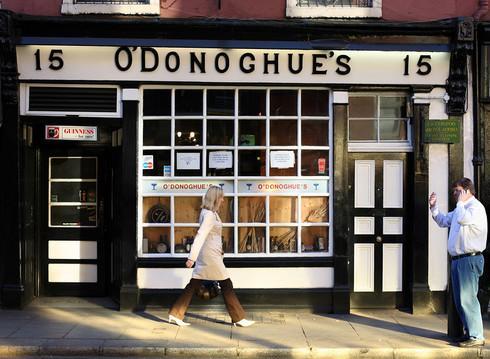
Gerard had a wide circle of friends amongst his neighbours and childhood friends, his involvement in the Scout Movement and in traditional Irish music circles. After leaving school he had a number of jobs before training as a baker and obtaining his City and Guilds with the major Dublin firm of Johnston, Mooney and O’Brien and afterwards did a number of jobs in catering and in music. Traditional Irish Music was his great love and he was an accomplished balladeer and guitarist who occupied regular pitches at music sessions at the famous Brazen Head (the world’s oldest licensed premises and mentioned in Leon Uris’s “Trinity”) and in O’Donoghue’s in Merrion Row, Dublin. The latter establishment is the holy grail of traditional music famous as the launch pad of the Irish Folk Group “The Dubliner’s.”
Gerard was a talented musician and singer and with his natural sociability he was a fixture at social gatherings amongst his wide circle of friends. It was his music which first brought him to the “Next Parish to Ireland”, America where he married, set up home and had three children who are not yet teenagers.
He loved the outdoors and weekends in the countryside and was an enthusiastic member of 57th Dublin Venture Scouts. As well as his own unit Gerard often joined in events with 1st Dublin and 5th Port Scout Groups. We also remember him giving freely of his time and effort on two other projects.
Firstly, in the late 70’s and early 80’s he was involved with 64th Dublin Scout Group based in the basement of Eamonn Ceannt Tower in the Ballymun Public Housing complex in North Dublin. This was a unique experiment in Scouting Outreach in a deprived area and Gerard was always on hand when help or assistance was needed as he identified with the aim of bringing the benefits of the Scout Movement to youngsters who needed it most.
Hiking in Glenmalure, Co. Wicklow; Francis Caulfield, David Caldwell, Gerard Cowan, Síle Mc Inerney, Ann Paisley, Gay Spencer
Secondly and fittingly for one with such a musical bent he was very much involved in the great event at Woodstock! This was not the small event in upstate New York but the International Scout Jamboree held at Woodstock in County Kilkenny in 1978. Gerard was down most weekends in the year beforehand where we were based in Cullen’s Farmhouse constructing the infrastructure needed for an event with 7,000 visitors over 10 days in August 1978. In true “Bouncer” fashion there were many happy musical evenings in Cullen’s farmhouse and in the local hostelries in the village of Inistioge
As his Obituary from “The Day” shows he fitted a great deal into his 49 years and touched many people. He was not the most organised or, at times, the most rational of people but there was no doubting his love of life, his exuberance which earned him his nickname “Bouncer” or his happiness in the company of others particularly indulging his love of music and the outdoors.
At times like this there is no point in looking for fairness or reason in what has happened, death is always a glutton and it never seems more avaricious than when it takes those who are too young and relish life. Nobody could doubt Gerard’s love of people, his capacity for friendship and his zest for life. Our deepest sympathies go to his wife Michelle, his children Ciara, Ben, and Jamie Cowan and his family in Ireland.
Ar dheis Dé go raibh a hanam dílis.
Gerard P. Cowan
Born Dublin, Ireland, June 16, 1959
Died Pawcatuck, Connecticut, United States of America, February 2, 2009
Gerard Cowan was a wandering minstrel from the Emerald Isle whose love of music and restless nature brought him on a convoluted but fascinating journey over the course of his life. Gerard died in the United States in his adopted home of Pawcatuck, Connecticut on the 2nd February 2009 after battling for over 10 years against a brain tumour which was diagnosed not long after the birth of his three children. Pawcatuck is a small town of just over 5,000 people along the Pawcatuck River in the North Eastern corner of Connecticut on the Atlantic Coast. It is an old established town which is part of New London County and the Mechanic Street Historic District is a historic riverfront district on the National Register of Historic Places. It was a centre of engineering and textile manufacturing in New England from the 1800s and before that had a thriving seafaring and boat building tradition along the Mystic River. It is also the home of the Freedom Schooner “Amistad” made famous in the 1997 movie of the same name by Steven Spielberg about the 1839 mutiny aboard a slave ship which was travelling towards the Northeast Coast of America
Mystic Seaport
Gerard Cowan or "Bouncer" as he was nicknamed due to his exuberant character and physique was well liked amongst his friends in Dublin, in Scouting and in Traditional Music circles. Many of us met him last at Conor Maguire's funeral at the end of November 2008 in Dublin and while he was very obviously not himself he was still delighted to catch up with the old gang. I told him that Conor would have really appreciated he was there and he just said "Conor would have done the same for me." There was a lot of decency about Gerard and we felt for him in his fight against his illness. It is odd and unsettling that the two West Finglas friends who grew up two doors apart on Kildonan Avenue have gone from us in such a short time. Many people at that other sad occasion in Dublin had not seen Gerard for many years and were both shocked at the physical toll his illness had taken but delighted to meet him again after many years. The psychological toll on Gerard and those around him must have been immense as he had been told on a number of occasions that he had only months to live.
Gerard at Woodstock 1978
His obituary in his local paper “The Day” hints at the colour and variety which he packed into the 49 year long journey of his life;
“Pawcatuck - Gerard Patrick Cowan, 49, of Pawcatuck, beloved husband of Michelle Morris and father of Ciara, Ben, and Jamie Cowan, passed away, Monday, Feb. 2, 2009, at home after a long battle with a brain tumour. Born in Dublin, Ireland, he was the son of Margaret (Dignam) Cowan of Dublin, Ireland, and the late James Cowan. Gerard was a traditional Irish musician, and was also a veterinarian technician for many years in New Jersey, Michigan, and Virginia. At various points in his life he trained as a baker, worked as a tiler, was a stay-at-home dad with his triplets, and even a cowboy. He loved to fish, appreciated the outdoors and all wildlife, the Pittsburgh Steelers, and enjoyed listening to and playing traditional Irish music.
Besides his wife, children, and mother he leaves his sister and brother, Deirdre Duffy and her husband, Eric, and Robert Cowan and his wife, Ann, all of Swords, Ireland; a niece, Alana Witter; and his nephew, James Duffy.
A memorial service celebrating Gerard's life will be held Thursday, Feb. 5, at 11 a.m. at the Old Mystic United Methodist Church, 44 Main St., Old Mystic. There are no calling hours. The Mystic Funeral Home has charge of arrangements.
The family has asked any donations be made to Hospice of South-eastern Connecticut, 227 Dunham St., Norwich, CT 06360. The family invites you to visit www.mysticfuneralhome.com for the online guest book.”
Leading a music session in the Ballymun Scout Den
Gerard had a wide circle of friends amongst his neighbours and childhood friends, his involvement in the Scout Movement and in traditional Irish music circles. After leaving school he had a number of jobs before training as a baker and obtaining his City and Guilds with the major Dublin firm of Johnston, Mooney and O’Brien and afterwards did a number of jobs in catering and in music. Traditional Irish Music was his great love and he was an accomplished balladeer and guitarist who occupied regular pitches at music sessions at the famous Brazen Head (the world’s oldest licensed premises and mentioned in Leon Uris’s “Trinity”) and in O’Donoghue’s in Merrion Row, Dublin. The latter establishment is the holy grail of traditional music famous as the launch pad of the Irish Folk Group “The Dubliner’s.”
Gerard was a talented musician and singer and with his natural sociability he was a fixture at social gatherings amongst his wide circle of friends. It was his music which first brought him to the “Next Parish to Ireland”, America where he married, set up home and had three children who are not yet teenagers.
He loved the outdoors and weekends in the countryside and was an enthusiastic member of 57th Dublin Venture Scouts. As well as his own unit Gerard often joined in events with 1st Dublin and 5th Port Scout Groups. We also remember him giving freely of his time and effort on two other projects.
Firstly, in the late 70’s and early 80’s he was involved with 64th Dublin Scout Group based in the basement of Eamonn Ceannt Tower in the Ballymun Public Housing complex in North Dublin. This was a unique experiment in Scouting Outreach in a deprived area and Gerard was always on hand when help or assistance was needed as he identified with the aim of bringing the benefits of the Scout Movement to youngsters who needed it most.
Hiking in Glenmalure, Co. Wicklow; Francis Caulfield, David Caldwell, Gerard Cowan, Síle Mc Inerney, Ann Paisley, Gay Spencer
Secondly and fittingly for one with such a musical bent he was very much involved in the great event at Woodstock! This was not the small event in upstate New York but the International Scout Jamboree held at Woodstock in County Kilkenny in 1978. Gerard was down most weekends in the year beforehand where we were based in Cullen’s Farmhouse constructing the infrastructure needed for an event with 7,000 visitors over 10 days in August 1978. In true “Bouncer” fashion there were many happy musical evenings in Cullen’s farmhouse and in the local hostelries in the village of Inistioge
As his Obituary from “The Day” shows he fitted a great deal into his 49 years and touched many people. He was not the most organised or, at times, the most rational of people but there was no doubting his love of life, his exuberance which earned him his nickname “Bouncer” or his happiness in the company of others particularly indulging his love of music and the outdoors.
At times like this there is no point in looking for fairness or reason in what has happened, death is always a glutton and it never seems more avaricious than when it takes those who are too young and relish life. Nobody could doubt Gerard’s love of people, his capacity for friendship and his zest for life. Our deepest sympathies go to his wife Michelle, his children Ciara, Ben, and Jamie Cowan and his family in Ireland.
Ar dheis Dé go raibh a hanam dílis.
Gerard P. Cowan
Born Dublin, Ireland, June 16, 1959
Died Pawcatuck, Connecticut, United States of America, February 2, 2009