Showing posts with label Piccadilly Line. Show all posts

Tuesday, November 30, 2010

Holden goes Underground


Poster for the exhibition at Stockwell Station

One of my architectural heroes, Charles Holden - the architect famed for designing many of the iconic '20s and '30s Tube stations - is being celebrated at a free exhibition now showing at the V&A Museum. When using the Tube on a daily basis it is easy to forget its history, and the energy and vision it took to build them. The latest exhibition at the Architecture Gallery will hopefully act as a reminder, whilst revealing the lasting influence of Charles Holden’s work for London Transport.


Charles Holden


Charles Holden's first commission for the Underground this 1924 entrance to Westminster Station. Unfortunately it was demolished in 1999 when the station was rebuilt

This exhibition examines the designs carried out by Charles Holden and his architectural practice, Adams Holden and Pearson, for London Transport, undoubtedly his greatest and most successful patron. The full range of his work, from stations on the Northern line extension and refurbishment of Piccadilly Circus station through to his creation of a new London Underground headquarters at 55 Broadway and his iconic modernist station designs produced for the Piccadilly line extensions is on show. Holden's relationship with London Transport's chief executive, Frank Pick is also investigated as their collaboration and integrated approach to design and architecture was instrumental in shaping London Transport's corporate brand.


Holden's sketch for Highgate Station entrance - later re-named Archway RIBA Drawings Collection

Holden masterminded the design of 20 or so tube stations – those elegant red brick affairs best seen on the northern stretch of the Piccadilly Line. These in particular show off Holden’s principles of ‘total design’. Interiors, light fittings, clocks and tiles – everything in his buildings was crafted to work together harmoniously. Holden deserves to be better known. A contemporary of Charles Rennie Mackintosh, he too produced buildings of great originality, and, unlike his Scottish counterpart, enjoyed a much longer professional career. Stylistically his buildings are difficult to categorise. But large or small, his buildings stand proud, distinguishable from their neighbours by a strong feeling of mass and line.


South Wimbledon Station

As the Guardian Newspaper's Architectural correspondent (and former London Transport management trainee) Jonathan Glancey observed;

“The first of Charles Holden's tube stations for Frank Pick was Sudbury Town, on the Piccadilly line, opened in 1931. There had been nothing like this distinctly modern yet well-crafted building in Britain before. With typical modesty, Holden, a retiring, teetotal, vegetarian Quaker draper's son from Bolton, Lancashire, chose to describe his first modern masterpiece as "a brick box with a concrete lid. Possibly, just possibly, Holden meant something more.

I can't help thinking that this truly great and still under-rated English architect was thinking of Inigo Jones (1573-1652), who had instigated a revolution in British architecture in the reign of James I when he designed the country's first truly classical buildings. When his client Francis Russell, Earl of Bedford, asked Jones to add a chapel "as cheap as a barn" to his smart residential development built around the new Covent Garden piazza, the architect replied "then you shall have the handsomest barn in England". Sudbury Town station is surely transport design's equivalent of St Paul's, Covent Garden.”

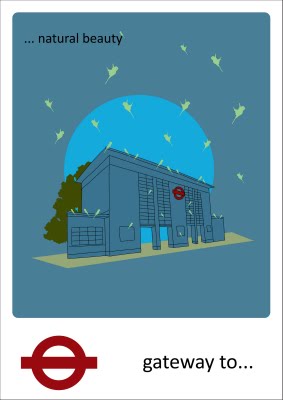


Sudbury Town station

Holden is best known for his work for London Underground in the 1920s and 1930s, when his office – Adams, Holden and Pearson – designed a series of underground stations of startling originality, like this at Rayners Lane. These play with basic geometry and volumes, and gain effect from the contrast of forms and materials, not decorative excess. In fact, this drawing of the new Rayners Lane station resembles the architecture itself: both are pared down. People, with their precise shadows, animate the building, not sculpture. Perhaps this architectural purity was regarded as excessive: it has been noted that the main hall of the station should have the addition of windows on either side.


Sketch for Rayners Lane Station


Cockfosters Station

The Directors of London Underground in the 20s and 30s saw good design as good for business. By the example it set under Frank Pick the Underground was gradually able to change the public’s attitude to railway stations which had been seen as shabby and inhospitable places. Sir Nicholas Pevsner wrote that Pick saw in every detail a “visual propaganda” and he used this not only to improve the Underground but the environment as a whole. Charles Holden brought the Underground station to the forefront of modern architecture: This achievement is unequalled by any other transport company before or since.


Ticket Hall with Passimeter


Escalators with bronze uplighters


55, Broadway - London Underground's iconic HQ built in 1929 in the "airspace" above St. James's Park Station

He was not universally admired and his huge complex for London University in Bloomsbury was considered cold by some critics. So much so that George Orwell modelled his Ministry of Truth, in his novel 1984, on Holden's 19 storey Senate House – Orwell's wife worked in the building for the censorship department of the Ministry of Information during WW11. There is a parallel for this as Ian Fleming objected so much to the modernist house the Hungarian architect Erno Goldfinger designed down the road from his house in Willow Road Hampstead that he gave his name to his first Bond villain. In the event Holden’s huge scheme for London University which would have involved buildings set around 17 courtyards was scaled back due to the onset of war.


Senate House. London University

This area around where the exhibition is being hosted at the Victoria and Albert Museum was dubbed by the Victorian press as Albertropolis' a name coined in the 1850s and resurrected in recent years for the 87-acre site south of Hyde Park, purchased by the Royal Commission for the Exhibition of 1851 with profits from the Great Exhibition. Exhibition Road - whose route the 440 yard subway from South Kensington Underground station follows - forms the spine of “Albertropolis”. The nickname satirised the vision of Prince Albert, the Commission's President, of the area as a centre for education, science and art - an ambition largely realised within a few decades of the Prince's death.


See; The Great Circle Line Journey

http://daithaic.blogspot.com/2008/01/great-circle-line-journey.html


The Royal Institute of British Artists (RIBA) and the V&A, with help from London Transport Museum, have pulled together this exhibition from original drawings, photographs, posters, film, journals and models from their extensive collections to tell the story behind Holden's modernist stations, many of which still serve Londoners today. It is well worth catching to understand this prolific and underrated architect who nonetheless has been hugely influential and whose designs have stood the test of time.


'Underground Journeys: Charles Holden's designs for London Transport' runs at the V&A+RIBA Architecture Gallery, V&A in South Kensington until February 13, 2011.

Website;

http://www.vam.ac.uk/exhibitions/index.html

See also;

Give my regards to 55, Broadway

http://daithaic.blogspot.com/2008/04/give-my-regards-to-55-broadway.html

Great British Design Quest

http://daithaic.blogspot.com/2009/01/great-british-design-quest.html

Mapping the World

http://daithaic.blogspot.com/2009/11/mapping-world.html

A night at the Museum

http://daithaic.blogspot.com/2010/01/night-at-museum.html


The Victoria & Albert Museum, South Kensington

For more see ARCHIBLOGS, TUBE BLOGS and TRANSPORT BLOGS in the Blog sidebar >>>>>

Holden goes Underground


Poster for the exhibition at Stockwell Station

One of my architectural heroes, Charles Holden - the architect famed for designing many of the iconic '20s and '30s Tube stations - is being celebrated at a free exhibition now showing at the V&A Museum. When using the Tube on a daily basis it is easy to forget its history, and the energy and vision it took to build them. The latest exhibition at the Architecture Gallery will hopefully act as a reminder, whilst revealing the lasting influence of Charles Holden’s work for London Transport.


Charles Holden


Charles Holden's first commission for the Underground this 1924 entrance to Westminster Station. Unfortunately it was demolished in 1999 when the station was rebuilt

This exhibition examines the designs carried out by Charles Holden and his architectural practice, Adams Holden and Pearson, for London Transport, undoubtedly his greatest and most successful patron. The full range of his work, from stations on the Northern line extension and refurbishment of Piccadilly Circus station through to his creation of a new London Underground headquarters at 55 Broadway and his iconic modernist station designs produced for the Piccadilly line extensions is on show. Holden's relationship with London Transport's chief executive, Frank Pick is also investigated as their collaboration and integrated approach to design and architecture was instrumental in shaping London Transport's corporate brand.


Holden's sketch for Highgate Station entrance - later re-named Archway RIBA Drawings Collection

Holden masterminded the design of 20 or so tube stations – those elegant red brick affairs best seen on the northern stretch of the Piccadilly Line. These in particular show off Holden’s principles of ‘total design’. Interiors, light fittings, clocks and tiles – everything in his buildings was crafted to work together harmoniously. Holden deserves to be better known. A contemporary of Charles Rennie Mackintosh, he too produced buildings of great originality, and, unlike his Scottish counterpart, enjoyed a much longer professional career. Stylistically his buildings are difficult to categorise. But large or small, his buildings stand proud, distinguishable from their neighbours by a strong feeling of mass and line.


South Wimbledon Station

As the Guardian Newspaper's Architectural correspondent (and former London Transport management trainee) Jonathan Glancey observed;

“The first of Charles Holden's tube stations for Frank Pick was Sudbury Town, on the Piccadilly line, opened in 1931. There had been nothing like this distinctly modern yet well-crafted building in Britain before. With typical modesty, Holden, a retiring, teetotal, vegetarian Quaker draper's son from Bolton, Lancashire, chose to describe his first modern masterpiece as "a brick box with a concrete lid. Possibly, just possibly, Holden meant something more.

I can't help thinking that this truly great and still under-rated English architect was thinking of Inigo Jones (1573-1652), who had instigated a revolution in British architecture in the reign of James I when he designed the country's first truly classical buildings. When his client Francis Russell, Earl of Bedford, asked Jones to add a chapel "as cheap as a barn" to his smart residential development built around the new Covent Garden piazza, the architect replied "then you shall have the handsomest barn in England". Sudbury Town station is surely transport design's equivalent of St Paul's, Covent Garden.”


Sudbury Town station

Holden is best known for his work for London Underground in the 1920s and 1930s, when his office – Adams, Holden and Pearson – designed a series of underground stations of startling originality, like this at Rayners Lane. These play with basic geometry and volumes, and gain effect from the contrast of forms and materials, not decorative excess. In fact, this drawing of the new Rayners Lane station resembles the architecture itself: both are pared down. People, with their precise shadows, animate the building, not sculpture. Perhaps this architectural purity was regarded as excessive: it has been noted that the main hall of the station should have the addition of windows on either side.


Sketch for Rayners Lane Station


Cockfosters Station

The Directors of London Underground in the 20s and 30s saw good design as good for business. By the example it set under Frank Pick the Underground was gradually able to change the public’s attitude to railway stations which had been seen as shabby and inhospitable places. Sir Nicholas Pevsner wrote that Pick saw in every detail a “visual propaganda” and he used this not only to improve the Underground but the environment as a whole. Charles Holden brought the Underground station to the forefront of modern architecture: This achievement is unequalled by any other transport company before or since.


Ticket Hall with Passimeter


Escalators with bronze uplighters


55, Broadway - London Underground's iconic HQ built in 1929 in the "airspace" above St. James's Park Station

He was not universally admired and his huge complex for London University in Bloomsbury was considered cold by some critics. So much so that George Orwell modelled his Ministry of Truth, in his novel 1984, on Holden's 19 storey Senate House – Orwell's wife worked in the building for the censorship department of the Ministry of Information during WW11. There is a parallel for this as Ian Fleming objected so much to the modernist house the Hungarian architect Erno Goldfinger designed down the road from his house in Willow Road Hampstead that he gave his name to his first Bond villain. In the event Holden’s huge scheme for London University which would have involved buildings set around 17 courtyards was scaled back due to the onset of war.


Senate House. London University

This area around where the exhibition is being hosted at the Victoria and Albert Museum was dubbed by the Victorian press as Albertropolis' a name coined in the 1850s and resurrected in recent years for the 87-acre site south of Hyde Park, purchased by the Royal Commission for the Exhibition of 1851 with profits from the Great Exhibition. Exhibition Road - whose route the 440 yard subway from South Kensington Underground station follows - forms the spine of “Albertropolis”. The nickname satirised the vision of Prince Albert, the Commission's President, of the area as a centre for education, science and art - an ambition largely realised within a few decades of the Prince's death.


See; The Great Circle Line Journey

http://daithaic.blogspot.com/2008/01/great-circle-line-journey.html


The Royal Institute of British Artists (RIBA) and the V&A, with help from London Transport Museum, have pulled together this exhibition from original drawings, photographs, posters, film, journals and models from their extensive collections to tell the story behind Holden's modernist stations, many of which still serve Londoners today. It is well worth catching to understand this prolific and underrated architect who nonetheless has been hugely influential and whose designs have stood the test of time.


'Underground Journeys: Charles Holden's designs for London Transport' runs at the V&A+RIBA Architecture Gallery, V&A in South Kensington until February 13, 2011.

Website;

http://www.vam.ac.uk/exhibitions/index.html

See also;

Give my regards to 55, Broadway

http://daithaic.blogspot.com/2008/04/give-my-regards-to-55-broadway.html

Great British Design Quest

http://daithaic.blogspot.com/2009/01/great-british-design-quest.html

Mapping the World

http://daithaic.blogspot.com/2009/11/mapping-world.html

A night at the Museum

http://daithaic.blogspot.com/2010/01/night-at-museum.html


The Victoria & Albert Museum, South Kensington

For more see ARCHIBLOGS, TUBE BLOGS and TRANSPORT BLOGS in the Blog sidebar >>>>>

Friday, June 26, 2009

Tunnel vision


In ancient Rome when the mob was getting anxious the nervous Emperor in his great palace on the Palatine Hill would lay on “Bread and Circuses” to placate the mob and stave off riots which might threaten his throne. So free food would be given out to the poor and bloody gladiatorial gore-fests would be staged at the Coliseum to entertain the restless mob. By the end of the Empire there was no substance left just Bread and Circuses. So what are we to make of the latest initiative on the London Underground against a background where line closures are beginning to bite hard? Want to go by Tube to the O2 this weekend? Forget it the Jubilee Line is COMPLETELY closed. Want to go to Heathrow Airport on the Piccadilly Line? You guessed it, it’s not a flyer! Want to go round the Circle Line? Sorry it’s not the Full Circle this weekend! Want to go to Amersham, Chesham or Watford on the Metropolitan Line? Forget it it’s better by bus, but not a disabled friendly bus as who takes phase 3 of the Disability Discrimination Act (since October 2006) seriously?


Heathrow is cut off this weekend

Against this background of widespread disruption and loss of service the London Evening Standard reports that drivers on the Piccadilly line are to operate on a higher plane by adding doses of philosophy to their daily announcements. Instead of simply apologising for delays while the service is regularised, operators can draw on the wisdom of Greek philosophers and political thinkers and the bon mots of Shakespeare to add variety to the day. All have been compiled by Turner Prize-winning artist Jeremy Deller in a passport-sized book which has been distributed to all the drivers and staff on the route. Well I wasted good money once going to see the Turner Prize so I wouldn’t take the fact that Jeremy Deller has won it as a positive reference!

http://daithaic.blogspot.com/2008/03/joseph-beuys-and-me.html

They range from the uplifting (“Nothing is worth more than this day” from Johann von Goethe, the German writer) to the sobering (“Man is in a strict sense entirely animal” — French mathematician and philosopher Blaise Pascal). The title of booklet is taken from Shakespeare's Coriolanus: “What is the City but the People?”

Mr Deller said: “I often wish announcements were more personal and reflected the realities and absurdities of living and working in a big city. I think the travelling public will enjoy some humour and unexpected insight during their journey.” London Underground hopes that by encouraging Tube staff to talk directly to customers with appropriate wit and wisdom, they will lift the moods of travellers.


Ja, Time is a variable on ze Tube

Transport for London is also handing over disused shop display cases at Piccadilly Circus for more art, including a bust of Jennifer Lopez, a floating starfish and a display of album covers.

How this entertainment on the Tube goes down with its Controller, that great classicist, The Emperor Boris is not known as he doesn’t appear to be a fan of public transport in practice? Boris Johnson's image as a bicycling, penny-pinching Mayor took a blow as it emerged that he had spent more than £4,500 of public money on taxis - with one bill alone topping £237. Indeed the difficulty of the approach of concentrating on Bread and Circuses and not substance was wonderfully illustrated last Monday week for an “Art on the Underground” special to celebrate 30 years of the Jubilee Line (the one which opened the year after the “Jubilee” and is closed this weekend) where free posters were being given out to customers as they experienced disrupted service on the err, eeerr, Jubilee Line!

Maybe the Emperor Boris needs to avert his gaze from his taxi receipts and stop the decline of his Empire?

Tunnel droppings – Here are some of the sayings which will either cheer you up or drive you insane on the Piccadilly Line. We apologise for this delay to your service, but to live is to dream...

In nature there are neither rewards nor punishments — there are consequences: Robert G. Ingersoll.

Beauty will save the world: Fydor Dostoevsky.

Hell is other people: Jean-Paul Sartre.

To live is to dream: Friedrich Schiller.

Life is one long process of getting tired: Samuel Butler.

Without music, life would be a mistake: Friedrich Nietzsche.

The only man who can change his mind is a man who's got one: Seneca.

An ounce of action is worth a ton of theory: Friedrich Engels.

The way to get things done is not to mind who gets the credit for doing them: Benjamin Jowett


Taxi!

And to show how ingrained The Tube is in the heart of the Nation the former paper of record, The Times, published the following today in its Leader column, no less!

Underground wisdom

Some suggestions for tags from philosophers on the London Tube announcements.

“All cha-a-ange at Earls Court for Southfields -

We are merely the stars' tennis balls, stuck and bandied which way please them: John Webster.”

“Mi-i-i-nd the gap - ...

Through me lies the way to the Ninth Circle Line: through me the way to eternal grief: Abandon all hope, you who enter the Underground: Dante.”

“Escalator work is taking place at Bank ...

Facilis descensus Averno: but to make your way out again to the upper air, that's the sweat: Virgil.”

“This train will not stop at Archway ...

Hell is other people: Jean-Paul Sartre.”

“This is the Mornington Crescent train ...


There is more to life than increasing its speed: Mahatma Gandhi.”

“Ickenham, Hillingdon, UXBRIDGE ...

To travel hopefully is better than to arrive: Robert Louis Stevenson.”

“Move right down the train ...

Out of the crooked timber of humanity no straight thing can ever be made: Kant”

“Let the passengers off first ...

Travel teaches toleration: Disraeli.”

“The northern exit at Notting Hill is closed until May 2020 for essential renovation work ...

What people travel for is a mystery: Thomas Babington Macaulay.”

“This train is now relocating from a Wimbledon to an Ealing Broadway train ...

The use of travelling is to regulate imagination by reality, and, instead of thinking how things may be, to see them as they are: Dr Johnson.”

Crackle. Bang. SCREECH. Such words of the sages will be wasted on the foetid Underground air unless they improve the deafening and inaudible Victorian communication equipment.

Tunnel vision


In ancient Rome when the mob was getting anxious the nervous Emperor in his great palace on the Palatine Hill would lay on “Bread and Circuses” to placate the mob and stave off riots which might threaten his throne. So free food would be given out to the poor and bloody gladiatorial gore-fests would be staged at the Coliseum to entertain the restless mob. By the end of the Empire there was no substance left just Bread and Circuses. So what are we to make of the latest initiative on the London Underground against a background where line closures are beginning to bite hard? Want to go by Tube to the O2 this weekend? Forget it the Jubilee Line is COMPLETELY closed. Want to go to Heathrow Airport on the Piccadilly Line? You guessed it, it’s not a flyer! Want to go round the Circle Line? Sorry it’s not the Full Circle this weekend! Want to go to Amersham, Chesham or Watford on the Metropolitan Line? Forget it it’s better by bus, but not a disabled friendly bus as who takes phase 3 of the Disability Discrimination Act (since October 2006) seriously?


Heathrow is cut off this weekend

Against this background of widespread disruption and loss of service the London Evening Standard reports that drivers on the Piccadilly line are to operate on a higher plane by adding doses of philosophy to their daily announcements. Instead of simply apologising for delays while the service is regularised, operators can draw on the wisdom of Greek philosophers and political thinkers and the bon mots of Shakespeare to add variety to the day. All have been compiled by Turner Prize-winning artist Jeremy Deller in a passport-sized book which has been distributed to all the drivers and staff on the route. Well I wasted good money once going to see the Turner Prize so I wouldn’t take the fact that Jeremy Deller has won it as a positive reference!

http://daithaic.blogspot.com/2008/03/joseph-beuys-and-me.html

They range from the uplifting (“Nothing is worth more than this day” from Johann von Goethe, the German writer) to the sobering (“Man is in a strict sense entirely animal” — French mathematician and philosopher Blaise Pascal). The title of booklet is taken from Shakespeare's Coriolanus: “What is the City but the People?”

Mr Deller said: “I often wish announcements were more personal and reflected the realities and absurdities of living and working in a big city. I think the travelling public will enjoy some humour and unexpected insight during their journey.” London Underground hopes that by encouraging Tube staff to talk directly to customers with appropriate wit and wisdom, they will lift the moods of travellers.


Ja, Time is a variable on ze Tube

Transport for London is also handing over disused shop display cases at Piccadilly Circus for more art, including a bust of Jennifer Lopez, a floating starfish and a display of album covers.

How this entertainment on the Tube goes down with its Controller, that great classicist, The Emperor Boris is not known as he doesn’t appear to be a fan of public transport in practice? Boris Johnson's image as a bicycling, penny-pinching Mayor took a blow as it emerged that he had spent more than £4,500 of public money on taxis - with one bill alone topping £237. Indeed the difficulty of the approach of concentrating on Bread and Circuses and not substance was wonderfully illustrated last Monday week for an “Art on the Underground” special to celebrate 30 years of the Jubilee Line (the one which opened the year after the “Jubilee” and is closed this weekend) where free posters were being given out to customers as they experienced disrupted service on the err, eeerr, Jubilee Line!

Maybe the Emperor Boris needs to avert his gaze from his taxi receipts and stop the decline of his Empire?

Tunnel droppings – Here are some of the sayings which will either cheer you up or drive you insane on the Piccadilly Line. We apologise for this delay to your service, but to live is to dream...

In nature there are neither rewards nor punishments — there are consequences: Robert G. Ingersoll.

Beauty will save the world: Fydor Dostoevsky.

Hell is other people: Jean-Paul Sartre.

To live is to dream: Friedrich Schiller.

Life is one long process of getting tired: Samuel Butler.

Without music, life would be a mistake: Friedrich Nietzsche.

The only man who can change his mind is a man who's got one: Seneca.

An ounce of action is worth a ton of theory: Friedrich Engels.

The way to get things done is not to mind who gets the credit for doing them: Benjamin Jowett


Taxi!

And to show how ingrained The Tube is in the heart of the Nation the former paper of record, The Times, published the following today in its Leader column, no less!

Underground wisdom

Some suggestions for tags from philosophers on the London Tube announcements.

“All cha-a-ange at Earls Court for Southfields -

We are merely the stars' tennis balls, stuck and bandied which way please them: John Webster.”

“Mi-i-i-nd the gap - ...

Through me lies the way to the Ninth Circle Line: through me the way to eternal grief: Abandon all hope, you who enter the Underground: Dante.”

“Escalator work is taking place at Bank ...

Facilis descensus Averno: but to make your way out again to the upper air, that's the sweat: Virgil.”

“This train will not stop at Archway ...

Hell is other people: Jean-Paul Sartre.”

“This is the Mornington Crescent train ...


There is more to life than increasing its speed: Mahatma Gandhi.”

“Ickenham, Hillingdon, UXBRIDGE ...

To travel hopefully is better than to arrive: Robert Louis Stevenson.”

“Move right down the train ...

Out of the crooked timber of humanity no straight thing can ever be made: Kant”

“Let the passengers off first ...

Travel teaches toleration: Disraeli.”

“The northern exit at Notting Hill is closed until May 2020 for essential renovation work ...

What people travel for is a mystery: Thomas Babington Macaulay.”

“This train is now relocating from a Wimbledon to an Ealing Broadway train ...

The use of travelling is to regulate imagination by reality, and, instead of thinking how things may be, to see them as they are: Dr Johnson.”

Crackle. Bang. SCREECH. Such words of the sages will be wasted on the foetid Underground air unless they improve the deafening and inaudible Victorian communication equipment.

Monday, January 12, 2009

Seats on Feet!


Neanderthal Man

A bane of the regular commuter are the Neanderthal ignoramuses who insist on rudely displaying their genetic inbreeding by using other people’s seats on public transport as a footrest. Indeed due to lack of enforcement by transport operator’s many do this deliberately as a Yob badge of honour normally combined with a “what’s your problem, Mate!” stare as staff major on their “non-confrontational” training and walk on by. I suspect these are the same people who take pride stealing disabled people’s parking spaces normally with their kids in the back seat so they learn by example and the Neanderthal genes are preserved for posterity. Never mind the disrespect to their fellow passengers and the fact that they look stupid (not that they consider this a disadvantage in life!) but analysis of such seat covers generally shows materials not normally found outside forensic science programmes!

Well one enterprising company called TRiP has a new take on this age old problem as it asks its customers to please put seats on feet! The concept is brilliant as London Transport moquette is an iconic fabric and is sold by the London Transport Museum as a successful furniture range.

http://daithaic.blogspot.com/2007/11/londons-transport-museum.html

The hard wearing, iconic patterned fabric seems perfect for footwear and we definitely approve Trip’s recycling ethic: "they incorporate recycled tyre rubber in the soles, restored Tube and bus seat textiles in the uppers and re-used leather cheque book wallets in the trim". If the wallets were collected from the Lost Property Office in Baker Street, then even better!


Moquette Furniture from the LTM Collection

Moquette was used on bus and tube seats from the 30s through to the 70s, a tough fabric able to take the wear and tear of constant daily use. But it wasn't just functional - designers were constantly brought in to liven up the fabric, creating looks that are both stylish and very distinct to their eras.

Each Tube design in the “Above+Below London” footwear is named after the line that supplied the fabric - such as District Line - and all the soles are made from 33 per cent bus tyre rubber. Robert Taylor, of Transport Recycling in Partnership (TRiP), said: “We have used good quality materials which would otherwise have ended up in landfill sites or going to an incinerator. I think the shoes have a real cultural, nostalgic feel to them.” They cost £60, and for every pair sold TRiP promises to plant one tree inside the M25.

The collection exclusively incorporates rare, vintage and ultra rare iconic retro textiles from the 50's, 60's, 70's, 80's and 90's reclaimed from seats on London's Underground tube carriages and buses. Realising these visually striking fabrics were genuine relics of London's design heritage, Central Saint Martin's college graduate Robert Taylor and music promoter/film maker Caroline Read collected and preserved them before they were lost to landfill or incineration forever!


Piccadilly

This design was used on Piccadilly Line Tube stock delivered from 1956 to 1967. The black vertical and red horizontal lines of varying thicknesses against a grey background were also found on the Metropolitan, Central, Northern and Victoria lines.

This line was originally called the Great Northern, Piccadilly, and Brompton Railway. It opened in December 1906 between Hammersmith and Finsbury Park. In 1932, extensions allowed passengers to travel north to Cockfosters and west to Hounslow and Uxbridge. The next major extension connected Heathrow Airport with central London in 1977. The loop to Terminal 4 was completed in 1986, and the line now serves the new Terminal 5 from 2008.


Victoria Line

This Victoria Line moquette design was used during the 1993 refurbishment of 1967 stock on the Victoria line. The sample has broad vertical red and blue stripes with a stepped repeating dark blue, white and red geometric 'arrow' motif. It was created by design consultants Jones Garrard and Tilney, Lumsden and Shane and produced in different colours, though they were never used. The refurbishment also included new grab-poles and armrests that were blue, symbolising the Victoria line. The design was influenced by the bright and bold moquette patterns used on London Transport during the 1930s and 1940s.

This brightly coloured District Line design from the late 1970's has a geometric pattern of repeating rows of orange, yellow, brown and black rectangles. When the surface stock cars on the District line were renewed, the mainly grey finishes of the old interiors were replaced by brighter designs. The new interiors were designed by Misha Black Design Research Unit. The internal doors were painted orange and the moquette matched the colour scheme. This pattern was also used on the Metro and Titan buses, which were introduced about the same time as D78 stock.


District Line

Fashion meets public transport in this new range of shoes made of recycled fabric from London Underground and bus seats and this is an idea which deserves to walk! Indeed the Sage may himself purchase a different design for his left and right feet as his avant garde development on cross dressing, let’s hear it for interchange dressing! Give it time and it could be a New Underground Movement!

See (and order!) on TRiP’s website here;

http://www.urbanremade.com/catalog/about_us.php?osCsid=487505787de14d4cd2a7f8e3e98812a1

And here is the link to the Moquette Furniture Collection on the London Transport Museum site;

http://www.ltmuseumshop.co.uk/LTM/Furniture-collection/Living.html