Showing posts with label Underground. Show all posts

Monday, January 10, 2011

The Bare Tube


Well Flash Mobbing gets a whole new meaning with the second "No Trousers on the Tube" day which was held yesterday and is an import from New York (where else?) which has been holding a “No Pants on the Subway” day for the past ten years. Last year the organisers claimed over 30 Londoners took part. The 2nd Annual No Trousers Tube Ride in London took place on Sunday 9th January. 3,500 people participated in New York and thousands more in 50 cities across the globe.

Full details can be found on;

http://improveverywhere.com/


Agent Eppink preaching for “Pro-Pants” in New York

The day originated in New York in 2002 as 'No Pants on the Subway' and has become a worldwide event in which travellers are invited to travel on the underground without trousers. The day of trouser-free travel was started by a group called Improv Everywhere in New York but it is now a global event. One of the places the event took place this year was Zurich, where scores of trouser less people were seen riding trams through the city's streets. For the third year in a row, there was a counter-contingent. The “Pro Pants” group was back once again to try to convert the trouser less to their pants-based religion. They went all out this year with pamphlets, sandwich boards, and free pairs of trousers.


London style

This year around 100 people braved the cold weather to ride the capital's underground system in their pants yesterday as part of the annual No Trousers Tube Ride: London. The thrill-seekers made the journey on the Bakerloo Line from Charing Cross to Paddington and back surrounded by bemused commuters who had no idea what was happening. The group event was a meticulously organised affair, with participants told to meet in front of the two fountains to the left of Nelson's Column in Trafalgar Square at 3pm sharp.


Justin Timberlake Tweets in support

Organisers then divided people into groups before everyone headed to Charing Cross Tube station. Once inside, they gathered on the northbound Bakerloo Line platform and got on the front carriage, where they removed their trousers and put them into a bag they had brought with them. They were instructed to pretend they didn't know each other and not to talk to other trouser less Tube passengers.


New York style

The two requirements for taking part in the event are a willingness to take your trousers off on the Tube and the ability to keep a straight face about it. Organisers say the bizarre spectacle is to promote more silliness in the world and give people something to laugh at.


New York's finest

I need hardly emphasise that this event is entirely unofficial, is not to be encouraged, probably breaches your conditions of carriage and if you meet a Police Officer on the Tube they would be fully entitled to take down your particulars.

http://www.flashmob.co.uk/index.php/site/page/no_trousers_tube_ride_london/

The Bare Tube


Well Flash Mobbing gets a whole new meaning with the second "No Trousers on the Tube" day which was held yesterday and is an import from New York (where else?) which has been holding a “No Pants on the Subway” day for the past ten years. Last year the organisers claimed over 30 Londoners took part. The 2nd Annual No Trousers Tube Ride in London took place on Sunday 9th January. 3,500 people participated in New York and thousands more in 50 cities across the globe.

Full details can be found on;

http://improveverywhere.com/


Agent Eppink preaching for “Pro-Pants” in New York

The day originated in New York in 2002 as 'No Pants on the Subway' and has become a worldwide event in which travellers are invited to travel on the underground without trousers. The day of trouser-free travel was started by a group called Improv Everywhere in New York but it is now a global event. One of the places the event took place this year was Zurich, where scores of trouser less people were seen riding trams through the city's streets. For the third year in a row, there was a counter-contingent. The “Pro Pants” group was back once again to try to convert the trouser less to their pants-based religion. They went all out this year with pamphlets, sandwich boards, and free pairs of trousers.


London style

This year around 100 people braved the cold weather to ride the capital's underground system in their pants yesterday as part of the annual No Trousers Tube Ride: London. The thrill-seekers made the journey on the Bakerloo Line from Charing Cross to Paddington and back surrounded by bemused commuters who had no idea what was happening. The group event was a meticulously organised affair, with participants told to meet in front of the two fountains to the left of Nelson's Column in Trafalgar Square at 3pm sharp.


Justin Timberlake Tweets in support

Organisers then divided people into groups before everyone headed to Charing Cross Tube station. Once inside, they gathered on the northbound Bakerloo Line platform and got on the front carriage, where they removed their trousers and put them into a bag they had brought with them. They were instructed to pretend they didn't know each other and not to talk to other trouser less Tube passengers.


New York style

The two requirements for taking part in the event are a willingness to take your trousers off on the Tube and the ability to keep a straight face about it. Organisers say the bizarre spectacle is to promote more silliness in the world and give people something to laugh at.


New York's finest

I need hardly emphasise that this event is entirely unofficial, is not to be encouraged, probably breaches your conditions of carriage and if you meet a Police Officer on the Tube they would be fully entitled to take down your particulars.

http://www.flashmob.co.uk/index.php/site/page/no_trousers_tube_ride_london/

Thursday, November 18, 2010

Blitz on the Underground


On the 70th anniversary of the Blitz on London survivors stepped back in time when they relived their experiences sheltering from Nazi bombs in London Underground stations during the Second World War. Providing a refuge from waves of attack bombers, Tube stations across London became impromptu shelters, saving thousands of lives in the process.


Aldwych Tube Station with the tiling showing the original name "Strand"

Aldwych, one of the first to be used as an air raid shelter, is being reopened to mark the anniversary. The station has been closed for 16 years, but it has reopened for tours to commemorate the Battle of Britain. An original 1938 train and a vintage bus parked outside the station - which was taken out of use in 1994 - enhanced the wartime atmosphere. The shelters saw crowds of people attempt to sleep on cramped, smelly platforms. Blitz survivors were invited to the station to relive their experiences ahead of its opening to the public.


The appearance of German bombers in the skies over London during the afternoon of September 7, 1940 heralded a tactical shift in Hitler's attempt to subdue Great Britain. This was the beginning of the Blitz - a period of intense bombing of London and other cities that continued until the following May. For the next consecutive 57 days, London was bombed either during the day or night. Fires consumed many portions of the city. Residents sought shelter wherever they could find it - many fleeing to the Underground stations that sheltered as many as 177,000 people during the night. In the worst single incident, 450 were killed when a bomb destroyed a school being used as an air raid shelter. Londoners and the world were introduced to a new weapon of terror and destruction in the arsenal of twentieth century warfare. The Blitz ended on May 11, 1941 when Hitler called off the raids in order to move his bombers east in preparation for Germany's invasion of Russia.


Air Raid Warden

People in London also used tube stations during the Blitz. They would buy a platform tickets and camp on the platforms for the night. Sheltering in the tube was popular because it was dry, warm and quiet down there. The government was afraid that the overcrowded platforms would disrupt the movement of troops and tried to stop the public from using the tube stations as shelters. The people refused to give them up and the government was forced to back down. In some cases underground stations were closed down and given over to the public to use during air raids.


The tube stations were not as safe as people thought. High explosive bombs dropped by the Luftwaffe could penetrate up to fifty feet through solid ground. On 17th September 1940, a bomb killed twenty people sheltering in Marble Arch station. The worst incident took place at Balham in October 1940 when 600 people were killed or injured when bombs burst a water main and the station flooded, an incident depicted in the movie “Atonement.”. The following year 111 people were killed while sheltering at the Bank underground station. One night 178 people suffocated at Bethnal Green station after a panic stampede, the worst civilian disaster of WW11 in Britain.

http://daithaic.blogspot.com/2010/02/bethnal-green-tube-disaster.html


Sheltering in Aldwych

A census held in November 1940 discovered that the majority of people in London did not use specially created shelters. The survey revealed that of those interviewed, 27 % used domestic shelters (i.e. Anderson Shelters), and 9 % slept in public shelters (specially built by the local authorities) and 4 % used underground railway stations. The rest of those interviewed were either on duty at night or slept in their own homes.


Because many people preferred to stay in their own homes during the bombing raids the government decided to look for a way of protecting people in their own homes. So in March 1941 the government began issuing Morrison Shelters, basically metal cages with a steel top which you could also use as a kitchen table!


Aldwych station which closed down 16 years ago was a strange station, connected by a shuttle service to Holborn Station which was just 10 minutes walk away. It only makes sense if you realise that the route was meant to connect to the mainline station at Waterloo but the line never made it under the river, the money ran out. It then had a potential new lease of life in the 70’s as it was meant to be a station on the “Fleet Line” which was the planned continuation of the Jubilee Line from it’s original terminus at Charing Cross. In an indication of the ability of Governments to waste money the tunnels were actually built from Charing X to Aldwych but when the Jubilee Line extension was opened to Canary Wharf in 1999 the Charing X Branch was closed.


Aldwych was closed in the 1990s due to lack of use but has often been used as a movie location. To commemorate the Blitz and the resilience of Londoners in the face of bombing it has now been done up as a Second World War tube station, with a series of 1940s carriages decked out with London Transport posters and wartime ads. The station was used as an air raid shelter and it doesn’t take much imagination to go back in time – the surroundings are almost completely unchanged from the 40s.
London Transport Museum, who organised the event, have gone all-out in recreating the look and feel of 1940s London. Visitors descending into the station were guided by staff in period costumes - including one acting as an air-raid warden. An original 1938 train and a vintage bus were parked outside the station enhance the wartime atmosphere.


Contemporary posters adorned the ticket hall, and as you entered the station, an ARP warden is out to tell us what you can expect once you’re below. Suddenly, the air raid siren is sounding, and you are ushered down the steps to platform level. Reaching the bottom, you're given a stiff talking to by a matronly Women's Voluntary Service (WVS) cadet, before being taken onto the platform, where London Underground's 1938-built Northern line train is waiting at the platform. Boarding the train, you encounter and greet a few more characters, before suddenly the tunnel is filled with the deafening sound of the air raid siren and the rumble of bombs falling above.


London Transport Museum has clearly gone to a lot of effort for this event, and they've been rewarded by the popularity - tickets were swiftly snapped up when they went on sale. Hopefully the success will inspire TfL to open up more of London's hidden pieces of transport infrastructure in the future. But it seems a pity to waste Aldwych’s potential and it would be wonderful to see the station reopen, restored and with the lifts working, as a permanent Blitz exhibition as this is a place with real history and character.

In the meantime, we recommend a visit to the Museum's current show. Under Attack: London, Coventry, Dresden, which runs until 31st March 2011. The aerial bombing raids, known in Britain as the Blitz, defined the wartime experience of many European cities. This exhibition tells the story from the perspective of public transport in London, Coventry and Dresden, and illustrates the struggle to keep these cities moving during the Second World War.


1938 Tube Stock

The exhibition has been developed in partnership with Coventry Transport Museum and the Verkehrsmuseum Dresden, to commemorate the 70th anniversary of the start of the Blitz in England and the 65th anniversary of the Dresden bombing.
The exhibition focuses on the role that public transport played in helping to create a sense of identity and normality. In particular, it seeks to explore the areas of commonality, as well as difference, and convey the shared experience of people from all walks of life - irrespective of nationality.


The exhibition explores some of the myths and reality of the wartime experience and reviews the changing nature of popular memory in relation to the Blitz attacks in England and the Firestorm in Dresden. A series of unique displays shows how each city prepared for war and the contrasting role of their transport systems. In London and Coventry, public transport was used to evacuate children and others out of the city, whilst in Dresden; the city itself was regarded as a shelter with transport bringing refugees into the centre. Visitors are encouraged to consider the effect of the bombing campaigns and reflect on the part played by transport in keeping the cities moving and in bolstering public morale in the face of attack.


In all well worth catching and let’s hope in the future Aldwych Station will have a starring role as the unique setting for its own expedition.


Exhibition at London’s Transport Museum

http://www.ltmuseum.co.uk/whats-on/events/exhibitions

London’s Transport Museum

http://daithaic.blogspot.com/2007/11/londons-transport-museum.html

The effect of the Blitz on the historic City of Coventry

http://daithaic.blogspot.com/2010/11/moonlight-sonata_14.html


For more see TUBE BLOGS and TRANSPORT BLOGS in the Blog sidebar >>>>>

Blitz on the Underground


On the 70th anniversary of the Blitz on London survivors stepped back in time when they relived their experiences sheltering from Nazi bombs in London Underground stations during the Second World War. Providing a refuge from waves of attack bombers, Tube stations across London became impromptu shelters, saving thousands of lives in the process.


Aldwych Tube Station with the tiling showing the original name "Strand"

Aldwych, one of the first to be used as an air raid shelter, is being reopened to mark the anniversary. The station has been closed for 16 years, but it has reopened for tours to commemorate the Battle of Britain. An original 1938 train and a vintage bus parked outside the station - which was taken out of use in 1994 - enhanced the wartime atmosphere. The shelters saw crowds of people attempt to sleep on cramped, smelly platforms. Blitz survivors were invited to the station to relive their experiences ahead of its opening to the public.


The appearance of German bombers in the skies over London during the afternoon of September 7, 1940 heralded a tactical shift in Hitler's attempt to subdue Great Britain. This was the beginning of the Blitz - a period of intense bombing of London and other cities that continued until the following May. For the next consecutive 57 days, London was bombed either during the day or night. Fires consumed many portions of the city. Residents sought shelter wherever they could find it - many fleeing to the Underground stations that sheltered as many as 177,000 people during the night. In the worst single incident, 450 were killed when a bomb destroyed a school being used as an air raid shelter. Londoners and the world were introduced to a new weapon of terror and destruction in the arsenal of twentieth century warfare. The Blitz ended on May 11, 1941 when Hitler called off the raids in order to move his bombers east in preparation for Germany's invasion of Russia.


Air Raid Warden

People in London also used tube stations during the Blitz. They would buy a platform tickets and camp on the platforms for the night. Sheltering in the tube was popular because it was dry, warm and quiet down there. The government was afraid that the overcrowded platforms would disrupt the movement of troops and tried to stop the public from using the tube stations as shelters. The people refused to give them up and the government was forced to back down. In some cases underground stations were closed down and given over to the public to use during air raids.


The tube stations were not as safe as people thought. High explosive bombs dropped by the Luftwaffe could penetrate up to fifty feet through solid ground. On 17th September 1940, a bomb killed twenty people sheltering in Marble Arch station. The worst incident took place at Balham in October 1940 when 600 people were killed or injured when bombs burst a water main and the station flooded, an incident depicted in the movie “Atonement.”. The following year 111 people were killed while sheltering at the Bank underground station. One night 178 people suffocated at Bethnal Green station after a panic stampede, the worst civilian disaster of WW11 in Britain.

http://daithaic.blogspot.com/2010/02/bethnal-green-tube-disaster.html


Sheltering in Aldwych

A census held in November 1940 discovered that the majority of people in London did not use specially created shelters. The survey revealed that of those interviewed, 27 % used domestic shelters (i.e. Anderson Shelters), and 9 % slept in public shelters (specially built by the local authorities) and 4 % used underground railway stations. The rest of those interviewed were either on duty at night or slept in their own homes.


Because many people preferred to stay in their own homes during the bombing raids the government decided to look for a way of protecting people in their own homes. So in March 1941 the government began issuing Morrison Shelters, basically metal cages with a steel top which you could also use as a kitchen table!


Aldwych station which closed down 16 years ago was a strange station, connected by a shuttle service to Holborn Station which was just 10 minutes walk away. It only makes sense if you realise that the route was meant to connect to the mainline station at Waterloo but the line never made it under the river, the money ran out. It then had a potential new lease of life in the 70’s as it was meant to be a station on the “Fleet Line” which was the planned continuation of the Jubilee Line from it’s original terminus at Charing Cross. In an indication of the ability of Governments to waste money the tunnels were actually built from Charing X to Aldwych but when the Jubilee Line extension was opened to Canary Wharf in 1999 the Charing X Branch was closed.


Aldwych was closed in the 1990s due to lack of use but has often been used as a movie location. To commemorate the Blitz and the resilience of Londoners in the face of bombing it has now been done up as a Second World War tube station, with a series of 1940s carriages decked out with London Transport posters and wartime ads. The station was used as an air raid shelter and it doesn’t take much imagination to go back in time – the surroundings are almost completely unchanged from the 40s.
London Transport Museum, who organised the event, have gone all-out in recreating the look and feel of 1940s London. Visitors descending into the station were guided by staff in period costumes - including one acting as an air-raid warden. An original 1938 train and a vintage bus were parked outside the station enhance the wartime atmosphere.


Contemporary posters adorned the ticket hall, and as you entered the station, an ARP warden is out to tell us what you can expect once you’re below. Suddenly, the air raid siren is sounding, and you are ushered down the steps to platform level. Reaching the bottom, you're given a stiff talking to by a matronly Women's Voluntary Service (WVS) cadet, before being taken onto the platform, where London Underground's 1938-built Northern line train is waiting at the platform. Boarding the train, you encounter and greet a few more characters, before suddenly the tunnel is filled with the deafening sound of the air raid siren and the rumble of bombs falling above.


London Transport Museum has clearly gone to a lot of effort for this event, and they've been rewarded by the popularity - tickets were swiftly snapped up when they went on sale. Hopefully the success will inspire TfL to open up more of London's hidden pieces of transport infrastructure in the future. But it seems a pity to waste Aldwych’s potential and it would be wonderful to see the station reopen, restored and with the lifts working, as a permanent Blitz exhibition as this is a place with real history and character.

In the meantime, we recommend a visit to the Museum's current show. Under Attack: London, Coventry, Dresden, which runs until 31st March 2011. The aerial bombing raids, known in Britain as the Blitz, defined the wartime experience of many European cities. This exhibition tells the story from the perspective of public transport in London, Coventry and Dresden, and illustrates the struggle to keep these cities moving during the Second World War.


1938 Tube Stock

The exhibition has been developed in partnership with Coventry Transport Museum and the Verkehrsmuseum Dresden, to commemorate the 70th anniversary of the start of the Blitz in England and the 65th anniversary of the Dresden bombing.
The exhibition focuses on the role that public transport played in helping to create a sense of identity and normality. In particular, it seeks to explore the areas of commonality, as well as difference, and convey the shared experience of people from all walks of life - irrespective of nationality.


The exhibition explores some of the myths and reality of the wartime experience and reviews the changing nature of popular memory in relation to the Blitz attacks in England and the Firestorm in Dresden. A series of unique displays shows how each city prepared for war and the contrasting role of their transport systems. In London and Coventry, public transport was used to evacuate children and others out of the city, whilst in Dresden; the city itself was regarded as a shelter with transport bringing refugees into the centre. Visitors are encouraged to consider the effect of the bombing campaigns and reflect on the part played by transport in keeping the cities moving and in bolstering public morale in the face of attack.


In all well worth catching and let’s hope in the future Aldwych Station will have a starring role as the unique setting for its own expedition.


Exhibition at London’s Transport Museum

http://www.ltmuseum.co.uk/whats-on/events/exhibitions

London’s Transport Museum

http://daithaic.blogspot.com/2007/11/londons-transport-museum.html

The effect of the Blitz on the historic City of Coventry

http://daithaic.blogspot.com/2010/11/moonlight-sonata_14.html


For more see TUBE BLOGS and TRANSPORT BLOGS in the Blog sidebar >>>>>

Wednesday, November 3, 2010

A slow day in London Town


“Worst Tube strikes yet say commuters as walkouts cripple London” was the headline in today’s London Evening Standard. Commuters struggling to get to work were today caught in a war of words over the third 24-hour Tube strike in as many months. All 11 lines suffered major disruption, 80 stations were closed and 100 stations were picketed in a row with the RMT and TSSA unions over job cuts and ticket office closures. Union bosses and angry passengers claimed the service was “far worse” than during the two previous strikes. At Marylebone Station this morning the lack of alternatives to The Tube were evident. The “Marshall” at the taxi rank had added to the confusion by reversing the direction of flow of the queue but this didn’t really matter. As with the last strikes there were hardly any taxis at the ranks as the “City Boys” block book them as these titans of Casino Banking are more important to London than people who do real stuff. No sign of the extra buses either, rather the opposite as road works made the traffic in the area impossible. A 205 bus to Bow in East London turned up from Paddington already full and no sign of the No. 2 bus to Victoria.


Commuters struggling home this evening were warned to expect another Tube strike on November 29 and then a series of stoppages after Christmas. Union bosses said walkouts in January could be announced after a “truce” next month. Tens of thousands of passengers suffered today as the third 24-hour strike in as many months caused disruption across the network. All 11 lines suffered major problems or were suspended, 80 stations were closed and 100 stations were picketed in a row with the RMT and TSSA unions over job cuts and ticket office closures.

The Standard quoted commuters urging Boris Johnson to tell Tube workers “enough is enough”. A commuter from Richmond was quoted as saying said: “The strikes are obviously getting worse. I have to get a taxi instead.” A spokesman for the RMT said there was “no question” disruption was worse than the last strikes with leader Bob Crow saying: “Today's action is rock solid the length and breadth of the system.”


Covent Garden Tube Station

London Underground insisted it had more trains running and more stations open than before. Managing director Mike Brown said: “Despite the deluded claims by the RMT and TSSA leaderships the Tube service this morning is moving hundreds of thousands of people across London. Over 40% of our services are running, with all but one line being served and that is the Circle line, where almost every station is served by other lines. 75% of stations are being served, and we are keeping London moving.” LU said 50 trains were operating on the Northern compared with 29 last time. But a third of the line's 33 stations were closed because there were no staff to operate them, meaning that even though trains were running, commuters could not get onto the platforms to catch them.

Among the Tube stations closed during today were Charing Cross, Westminster, Piccadilly Circus and Knightsbridge as well as Heathrow Terminal 4. The Mayor came under renewed fire for not personally meeting the RMT and TSSA unions. A fourth walk-out is planned for November 29 and with no resolution to the dispute in sight passengers were warned of more strikes in the run-up to Christmas. London Underground said at the height of the morning peak period it was operating 44 per cent of services compared with 28 per cent last time.


Lines were either suspended over part of the route or ran with massive delays and cancellations. The Circle line will be suspended throughout the day and there was no service on the Waterloo and City lines for an essential part of the morning peak. Roger, travelling through Victoria, said: “It was terrible down there. It's the queuing to get into the station that's really bad. Some of the lines are totally crippled. People just have to get on with it as best they can.”


Gary, an IT trainer from Kent, said: “I can see these strikes going on for some time because their positions are fairly entrenched and it is difficult to see how a speedy resolution will be arrived at.” Mr Crow insisted that the strike was over “safe Tube staffing levels as our members send out the clearest possible message to the Mayor to call a halt to cuts before there's a major disaster”.


The conciliation service ACAS announced that fresh talks will be held tomorrow. The unions are protesting at plans to axe 800 mainly ticket office jobs, although they claim the number is set to rise to almost 2,000. TfL deny that safety is being compromised and insist there will be no enforced redundancies. While commuters in London had well practised strike routines, tourists to the city found their plans thrown into disarray.


Stefan from Berlin said: “It's a nightmare for people visiting London.” However the cutbacks in Underground are regarded as the thin end of a pointed political wedge to cutback the Underground which includes further redundancy, centralisation of HR, Finance and IT within the TfL organisation and selling off 55, Broadway, London Underground’s iconic and fully paid for Head Office (Estates Gazette February 14th 2009).

http://daithaic.blogspot.com/2008/04/give-my-regards-to-55-broadway.html

Whereas London Underground is being told to cut its cloth according to a recent BBC article on pay and bonuses TfL is very much committed to Rolls-Royce solutions with some employees on large salaries getting half as much again as bonuses.

http://www.bbc.co.uk/news/uk-11369278

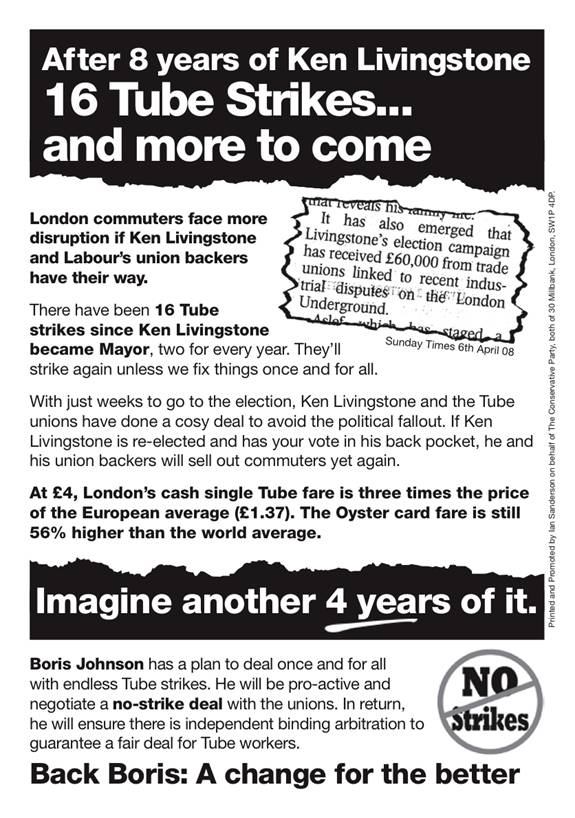
Having explicitly committed to no ticket office closures in his Mayoral election manifesto Mayor Boris Johnson is now hoisted on his own petard, so being Boris you then make noise about something nay anything and wave your arms frantically! So now Boris is on the news banging on about banning strikes where less than 50% of union members vote. This could also be an awkward argument for BoJo as such a "turnout threshold" would have prevented his own election on the back of just 19% of London voters.


And the only reason he is talking about one now is to cover for his total inaction in getting the promised "no strike deal" with the unions. So as you mull that one over on your journey home tonight here's a few other statistics from the “Tory Troll” Blog to think about:

Boris Johnson's meetings since 2008:

Rupert Murdoch: 1
Rebekah Wade, The Sun: 2
Lord Rothermere, Daily Mail: 1
Richard Madeley and Judy Finnigan: 1
Lily Allen: 1
Kelly Brook: 2
Tube Union leaders: 0


What Boris promised when running for election?


Boris discussing important matters with Lily Rose Beatrice Allen, a popular chanteuse. Who says Global warming is not real?